
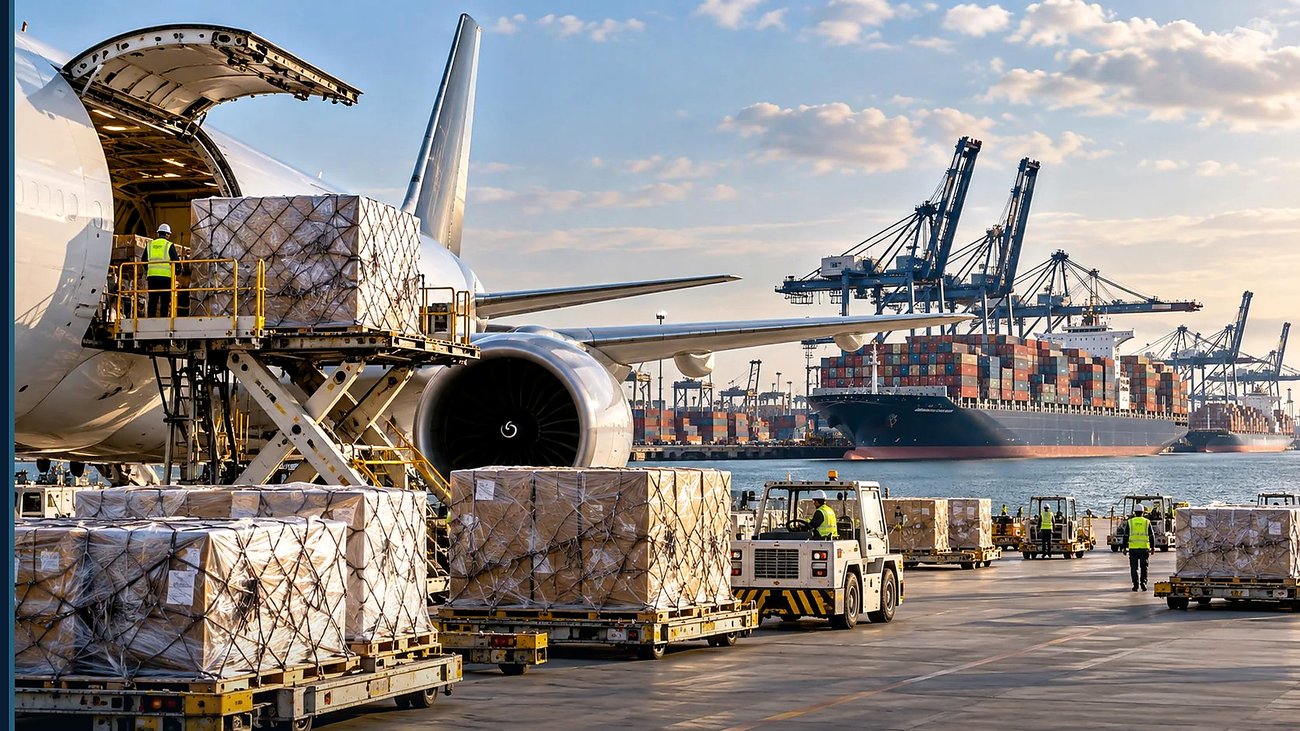
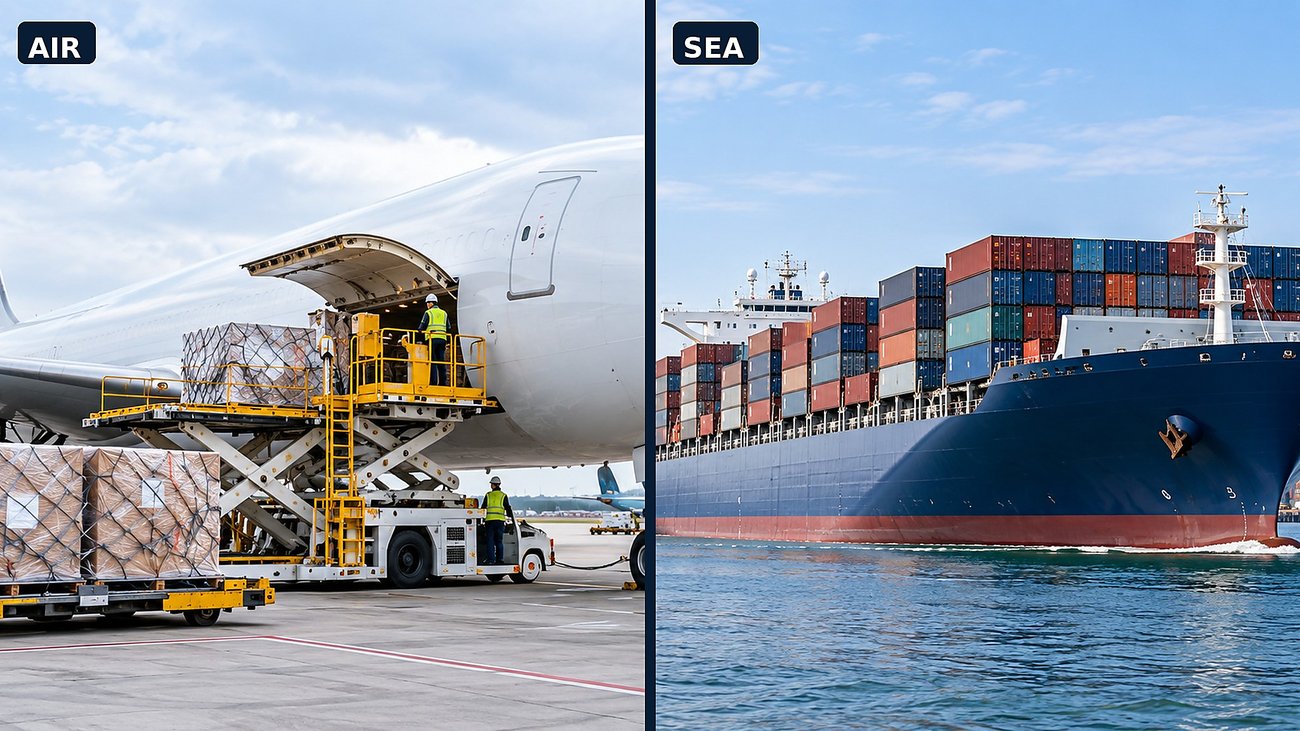
Air freight and sea freight solve different supply-chain problems. Air buys time at a higher transport cost. Sea buys lower unit freight cost with longer and more variable lead time. The business decision is therefore not “Which mode is cheaper?” but “What is the economic value of the time and capacity each mode provides?”
Importers that make this decision well connect freight with inventory planning, margin, product value density and demand volatility. They also avoid comparing incomplete rates: airport-to-airport versus door-to-door, or ocean port-to-port versus delivered cost.
Start with the required inventory date
Define the latest acceptable warehouse receipt date and work backward through customs, arrival, main carriage, origin handling and cargo readiness. For air-freight planning, speed should be purchased deliberately. The team should know what business event the extra transport cost is protecting, how much quantity actually needs premium transport and which milestone would justify changing the original plan.
A nominal flight time or vessel transit does not represent the whole shipment lead time. For air-freight planning, speed should be purchased deliberately. The team should know what business event the extra transport cost is protecting, how much quantity actually needs premium transport and which milestone would justify changing the original plan.
If the inventory date is flexible, ocean economics are usually easier to justify. If the date is critical, air can protect revenue or production. For air-freight planning, speed should be purchased deliberately. The team should know what business event the extra transport cost is protecting, how much quantity actually needs premium transport and which milestone would justify changing the original plan.
Use realistic buffers based on the lane and season rather than planning to the best-case schedule. For air-freight planning, speed should be purchased deliberately. The team should know what business event the extra transport cost is protecting, how much quantity actually needs premium transport and which milestone would justify changing the original plan.
Understand how each mode is billed
Air freight usually bills on chargeable weight, using the higher of actual and volumetric weight under the applicable rule. For air-freight planning, speed should be purchased deliberately. The team should know what business event the extra transport cost is protecting, how much quantity actually needs premium transport and which milestone would justify changing the original plan.
Sea LCL commonly bills on volume with minimums; FCL is container-based. For air-freight planning, speed should be purchased deliberately. The team should know what business event the extra transport cost is protecting, how much quantity actually needs premium transport and which milestone would justify changing the original plan.
Packaging design can therefore have different economic effects by mode. Reducing carton dimensions can materially lower air cost even if actual weight is unchanged. For air-freight planning, speed should be purchased deliberately. The team should know what business event the extra transport cost is protecting, how much quantity actually needs premium transport and which milestone would justify changing the original plan.
Always compare rates on the same delivery scope. For air-freight planning, speed should be purchased deliberately. The team should know what business event the extra transport cost is protecting, how much quantity actually needs premium transport and which milestone would justify changing the original plan.
Which cargo tends to favor air freight
High-value, compact goods can tolerate a higher freight cost per kilogram because transport is a smaller share of product value. For air-freight planning, speed should be purchased deliberately. The team should know what business event the extra transport cost is protecting, how much quantity actually needs premium transport and which milestone would justify changing the original plan.
Urgent replacement parts, launch inventory and stockout recovery are classic air-freight cases. For air-freight planning, speed should be purchased deliberately. The team should know what business event the extra transport cost is protecting, how much quantity actually needs premium transport and which milestone would justify changing the original plan.
Temperature, security or handling requirements may also influence mode choice, subject to carrier acceptance. For air-freight planning, speed should be purchased deliberately. The team should know what business event the extra transport cost is protecting, how much quantity actually needs premium transport and which milestone would justify changing the original plan.
Air is less attractive for bulky, low-value goods where volumetric weight creates a very high freight-to-value ratio. For air-freight planning, speed should be purchased deliberately. The team should know what business event the extra transport cost is protecting, how much quantity actually needs premium transport and which milestone would justify changing the original plan.
Which cargo tends to favor sea freight
Furniture, building products, large apparel programs and other high-volume goods generally benefit from ocean economics. For air-freight planning, speed should be purchased deliberately. The team should know what business event the extra transport cost is protecting, how much quantity actually needs premium transport and which milestone would justify changing the original plan.
FCL is especially useful when shipment size, packing and supply cadence support container utilization. For air-freight planning, speed should be purchased deliberately. The team should know what business event the extra transport cost is protecting, how much quantity actually needs premium transport and which milestone would justify changing the original plan.
Sea freight can also support planned safety stock and predictable replenishment programs. For air-freight planning, speed should be purchased deliberately. The team should know what business event the extra transport cost is protecting, how much quantity actually needs premium transport and which milestone would justify changing the original plan.
Very urgent, perishable or production-critical cargo may not tolerate the longer lead time. For air-freight planning, speed should be purchased deliberately. The team should know what business event the extra transport cost is protecting, how much quantity actually needs premium transport and which milestone would justify changing the original plan.
The inventory economics behind the decision
Ocean reduces transport spend but keeps inventory in the pipeline longer. For air-freight planning, speed should be purchased deliberately. The team should know what business event the extra transport cost is protecting, how much quantity actually needs premium transport and which milestone would justify changing the original plan.
Air raises transport spend but can lower the amount of safety stock needed for certain fast-moving or high-uncertainty products. For air-freight planning, speed should be purchased deliberately. The team should know what business event the extra transport cost is protecting, how much quantity actually needs premium transport and which milestone would justify changing the original plan.
The right model compares freight cost with working capital, lost-sales risk, markdown risk and production downtime. For air-freight planning, speed should be purchased deliberately. The team should know what business event the extra transport cost is protecting, how much quantity actually needs premium transport and which milestone would justify changing the original plan.
SKU segmentation often produces a better result than choosing one mode for the entire business. For air-freight planning, speed should be purchased deliberately. The team should know what business event the extra transport cost is protecting, how much quantity actually needs premium transport and which milestone would justify changing the original plan.
Hybrid air-sea strategies
When production is late, move a small quantity by air to protect the customer promise and send the balance by sea. For air-freight planning, speed should be purchased deliberately. The team should know what business event the extra transport cost is protecting, how much quantity actually needs premium transport and which milestone would justify changing the original plan.
For product launches, air can seed inventory while the normal ocean replenishment pipeline starts. For air-freight planning, speed should be purchased deliberately. The team should know what business event the extra transport cost is protecting, how much quantity actually needs premium transport and which milestone would justify changing the original plan.
For seasonal goods, use air only where forecast error creates a specific shortage instead of converting the entire program. For air-freight planning, speed should be purchased deliberately. The team should know what business event the extra transport cost is protecting, how much quantity actually needs premium transport and which milestone would justify changing the original plan.
Hybrid plans require good inventory visibility so teams know what quantity is truly urgent. For air-freight planning, speed should be purchased deliberately. The team should know what business event the extra transport cost is protecting, how much quantity actually needs premium transport and which milestone would justify changing the original plan.
Risk and disruption planning
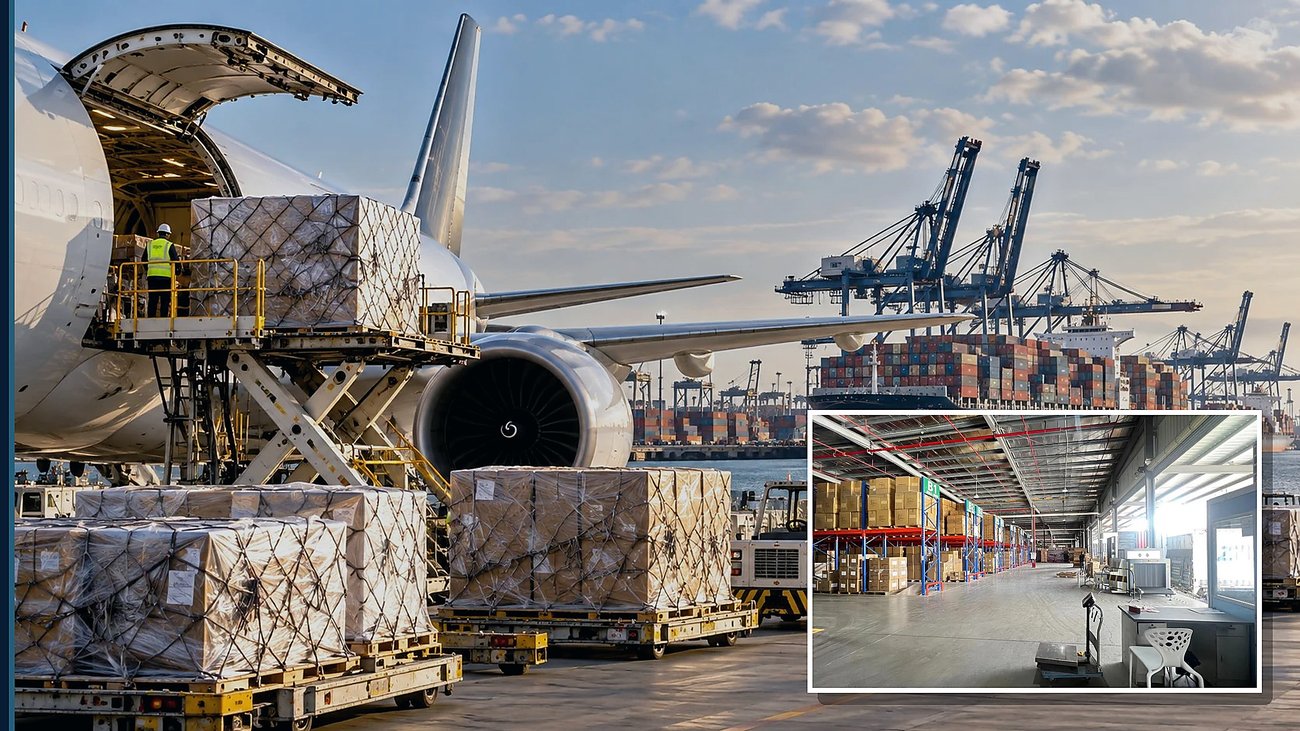
Air capacity can tighten quickly during peak periods or major disruptions. For air-freight planning, speed should be purchased deliberately. The team should know what business event the extra transport cost is protecting, how much quantity actually needs premium transport and which milestone would justify changing the original plan.
Ocean schedules can be affected by congestion, blank sailings, weather, route diversions and equipment constraints. For air-freight planning, speed should be purchased deliberately. The team should know what business event the extra transport cost is protecting, how much quantity actually needs premium transport and which milestone would justify changing the original plan.
Maintain alternative routings and decision thresholds for critical SKUs. For air-freight planning, speed should be purchased deliberately. The team should know what business event the extra transport cost is protecting, how much quantity actually needs premium transport and which milestone would justify changing the original plan.
Proactive milestone monitoring should trigger inventory decisions before the delay becomes a stockout. For air-freight planning, speed should be purchased deliberately. The team should know what business event the extra transport cost is protecting, how much quantity actually needs premium transport and which milestone would justify changing the original plan.
How to make the final choice
Calculate total door cost for both modes. For air-freight planning, speed should be purchased deliberately. The team should know what business event the extra transport cost is protecting, how much quantity actually needs premium transport and which milestone would justify changing the original plan.
Estimate the business value of the lead-time difference. For air-freight planning, speed should be purchased deliberately. The team should know what business event the extra transport cost is protecting, how much quantity actually needs premium transport and which milestone would justify changing the original plan.
Check cargo restrictions, dimensions and handling needs. For air-freight planning, speed should be purchased deliberately. The team should know what business event the extra transport cost is protecting, how much quantity actually needs premium transport and which milestone would justify changing the original plan.
Choose the mode that minimizes total supply-chain cost while meeting the service requirement. For air-freight planning, speed should be purchased deliberately. The team should know what business event the extra transport cost is protecting, how much quantity actually needs premium transport and which milestone would justify changing the original plan.
Decision table
| Decision area | What to confirm | Why it matters |
|---|---|---|
| Cargo facts | Commodity, cartons, actual weight, dimensions and handling characteristics | Freight pricing and carrier acceptance depend on the physical shipment, not only the purchase order. |
| Route scope | Pickup point, main mode, gateway and final delivery point | Two quotes are not comparable if they cover different segments of the journey. |
| Customs data | Description, value, classification, origin and importer/broker setup | Clean customs data reduces avoidable questions and supports landed-cost planning. |
| Inventory date | Required receipt date and acceptable schedule buffer | Mode and routing should protect the business requirement, not only minimize transport spend. |
| Exceptions | Storage, inspection, delay, redelivery and escalation process | A clear exception plan reduces surprise cost and decision time when the shipment deviates from plan. |
Importer checklist
- Cargo ready date
- Required inventory date
- Actual and volumetric weight
- CBM and container utilization
- Product value and gross margin
- Stockout or downtime cost
- Cargo restrictions
- Door-to-door cost for both modes
How the decision changes by destination market
United States
For the United States, combine freight planning with importer-of-record, customs-broker, tariff and final receiving requirements. Port or airport choice should be evaluated against domestic delivery, not in isolation. E-commerce and retailer programs can add appointment, labeling and compliance steps that deserve their own lead time. The same principle applies here: compare the complete operating chain and confirm market-specific requirements before cargo is committed to a route.
Canada
For Canada, destination geography can make final-mile cost a major share of the total shipment. Confirm customs and tax handling, then compare gateways based on the actual delivery province and warehouse rather than assuming the nearest international gateway is always best. The same principle applies here: compare the complete operating chain and confirm market-specific requirements before cargo is committed to a route.
United Kingdom
For the United Kingdom, treat customs and tax planning as a distinct destination workflow rather than an extension of EU processes. The consignee/importer setup, commodity data and final delivery appointment should be clear before departure. The same principle applies here: compare the complete operating chain and confirm market-specific requirements before cargo is committed to a route.
European Union
For EU destinations, customs, VAT structure, product regulation and intra-European distribution can interact. The best arrival gateway for a regional supply chain may differ from the country where the goods are ultimately sold, so legal and logistics planning should be aligned. The same principle applies here: compare the complete operating chain and confirm market-specific requirements before cargo is committed to a route.
Australia
For Australia, biosecurity and product-specific import conditions can be as important as the freight mode. Packaging materials, cargo cleanliness and accurate declarations should be reviewed early for relevant goods. The same principle applies here: compare the complete operating chain and confirm market-specific requirements before cargo is committed to a route.
UAE and Gulf markets
For the UAE and Gulf markets, door-delivery planning should reflect destination customs requirements, consignee readiness and local receiving conditions. Commercial-document accuracy and a clear final-mile contact reduce avoidable handoff delays. The same principle applies here: compare the complete operating chain and confirm market-specific requirements before cargo is committed to a route.
Frequently asked questions
How much faster is air freight?
Air is normally much faster in main carriage, but end-to-end lead time still includes origin handling, customs and delivery.
Is sea freight always cheaper?
For larger cargo it is often cheaper per unit, but the business should also consider inventory and delay costs.
What is volumetric weight?
A dimensional billing method used when cargo occupies more aircraft space than its actual weight suggests.
Can I combine air and sea freight?
Yes. Split shipments are a common inventory-risk strategy.
Which mode is better for e-commerce?
It depends on SKU margin, demand, urgency, carton density and fulfillment requirements.
How should I compare quotes?
Use the same pickup, destination and service scope, then compare total door cost and expected lead time.
Next steps
Before requesting a final freight rate, prepare the shipment facts and decide which trade-offs matter most: cost, timing, control, customs responsibility, delivery complexity or inventory risk. YUJINTONG can then review the cargo and build a route around those constraints rather than forcing every shipment into the same template.
Related resources: Air freight from China · Sea freight from China · Calculate volumetric weight
Operational field notes
A useful operating habit is to separate assumptions from confirmed facts. Supplier-provided dimensions, tentative cargo-ready dates and estimated customs classifications should be marked as provisional until the responsible party has verified them. This prevents planning documents from looking more certain than the underlying information really is. When a provisional assumption changes, the team can immediately see which rate, booking or inventory decision needs to be reviewed.
Procurement and logistics teams should also keep a short decision log for material route changes. Record why the original mode was selected, what event caused the change, which alternatives were considered and who approved the additional cost or timing trade-off. This creates better supplier and forwarder reviews later and avoids repeating the same debate during the next disruption.
Another improvement is to standardize shipment master data. A controlled file containing product descriptions, HS classifications used for planning, dimensions, battery status, packaging type, country of origin and compliance references reduces rework across quotations, bookings and customs communication. The data still needs route-specific validation, but teams start from a better baseline.
Visibility is most valuable when it is linked to action. Instead of collecting dozens of milestones, identify the moments that can change a business decision: supplier late, cargo measured differently, booking not confirmed, departure missed, customs hold, free time at risk or delivery appointment rejected. Each critical event should have an owner, a response target and an escalation path.
The financial review should continue after delivery. Compare the original planning estimate with the final freight invoice, customs charges, accessorials and delivery cost. Categorize every variance as forecast error, scope change, operational exception or supplier data issue. Over several shipments, this produces a much more reliable view of landed cost and forwarder performance than headline rate comparisons alone.
For repeat lanes, document a simple standard operating procedure covering booking lead time, required documents, warehouse cutoff, approval contacts, expected milestones and destination receiving rules. The SOP should be short enough that teams actually use it. Update it when a real shipment reveals a new risk or a better operating practice.
A useful operating habit is to separate assumptions from confirmed facts. Supplier-provided dimensions, tentative cargo-ready dates and estimated customs classifications should be marked as provisional until the responsible party has verified them. This prevents planning documents from looking more certain than the underlying information really is. When a provisional assumption changes, the team can immediately see which rate, booking or inventory decision needs to be reviewed.
Procurement and logistics teams should also keep a short decision log for material route changes. Record why the original mode was selected, what event caused the change, which alternatives were considered and who approved the additional cost or timing trade-off. This creates better supplier and forwarder reviews later and avoids repeating the same debate during the next disruption.