
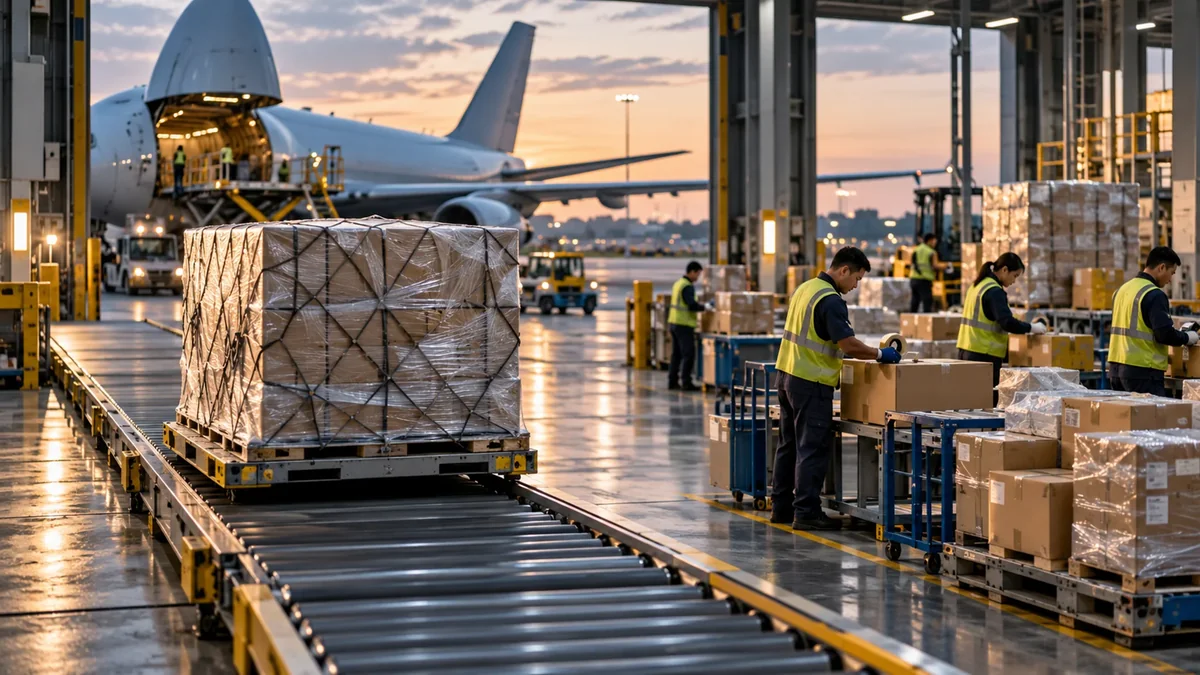
Direct shipment and consolidated airfreight solve different procurement problems. A direct shipment can preserve schedule control for one urgent lot, whereas consolidation exchanges that independence for coordinated handling across multiple suppliers or orders.
Illustrative planning case, not a booked DDP Atlas shipment. A small high-priority component arrives at the consolidation warehouse while another supplier misses its cargo-ready date. Splitting the critical item can protect a production line even if the remaining goods still benefit from consolidated handling.
Control data for consolidated versus direct uplift
| Priority | Evidence or input |
|---|---|
| 1 | Individual lot priority |
| 2 | Consolidation waiting time |
| 3 | Warehouse handling |
| 4 | Shared documentation |
| 5 | Cost allocation across orders |
| 6 | Split-release rules |
How to plan direct versus consol
For direct vs consolidated air freight, the warehouse process determines whether consolidation creates control or delay. Every supplier lot should arrive with a purchase-order or SKU reference, expected carton count and a clear instruction for discrepancies. Final weight and dimensions should be captured after any repacking or palletization.
Schedule versus rate
A consol is valuable only when its planned departure meets the business deadline.
For direct vs consolidated air freight, the warehouse process determines whether consolidation creates control or delay. Every supplier lot should arrive with a purchase-order or SKU reference, expected carton count and a clear instruction for discrepancies. Final weight and dimensions should be captured after any repacking or palletization.
The export plan should define the latest receiving time and what to do when one supplier is late. That decision is operationally important: waiting may reduce transport cost but miss the flight; splitting may protect the deadline but create an extra shipment and additional handling.
Illustrative planning case, not a booked DDP Atlas shipment. A small high-priority component arrives at the consolidation warehouse while another supplier misses its cargo-ready date. Splitting the critical item can protect a production line even if the remaining goods still benefit from consolidated handling.
Key takeaways
- Consolidated air freight can improve economics by grouping cargo into scheduled consol movements, while direct or back-to-back arrangements can give more routing control.
- The trade-off is not only speed; cut-off pattern, handling points, shipment size and destination deconsolidation also matter.
- Urgent cargo should not be placed into a consol solely because the rate is lower if its deadline is incompatible with the schedule.
- Measure cargo after final packing, not from supplier estimates.
- Use one receiving and exception process for multi-supplier consolidations.
The decision in one table
| Decision point | What to check |
|---|---|
| Receiving | Identify every supplier lot and record discrepancies before consolidation. |
| Measurement | Use final packed dimensions and weight after repacking/palletization. |
| Build plan | Decide carton, pallet and consolidation structure around loadability and handling. |
| Cut-off | Set a rule for late suppliers so one lot does not unexpectedly hold the whole shipment. |
Information to send for consolidated versus direct uplift
- Supplier list, pickup addresses and cargo-ready dates.
- Carton labels/SKU references and expected quantities.
- Warehouse receiving and discrepancy instructions.
- Final packing/palletization requirement.
- Latest acceptable export cut-off.
- Rule for splitting ready cargo if one supplier is late.
Planning example: consolidated versus direct uplift
A weekly consolidation has an attractive rate but departs after the buyer’s launch deadline. A more direct booking costs more but protects the business requirement. Service design wins over rate preference.
Frequently asked questions
Does consolidation always reduce cost?
Not automatically. It can reduce duplicated handling and create scale, but warehouse time, late suppliers and final chargeable weight must be considered.
Is an export pallet the same as an airline ULD?
No. A shipper pallet is cargo packaging/handling equipment. A ULD is part of the aircraft cargo system and is controlled within airline/ground-handling processes.
When should cargo be measured?
After final packing or palletization. That is the data most relevant to chargeable weight and loadability.
Before you book direct vs consolidated air freight: Separate flight time from total door-to-door time, and confirm the assumption you are relying on before the cargo-ready date. The shared operating sequence and pre-booking checklist live on the Air Freight from China hub.
Where consolidated versus direct uplift goes wrong
Where importers lose time or money. Risk 1: One supplier delays the entire consolidation. Risk 2: Final dimensions differ materially from supplier estimates. Risk 3: Palletization creates avoidable volumetric weight. Risk 4: Warehouse labels or SKU references are inconsistent.
Buyer control matrix.
When consolidation costs more than it saves
Consolidation is usually presented as a way to reach a better price band. There are conditions under which it does the opposite, and they are worth knowing before the shipment is built.
| Situation | What consolidation does |
|---|---|
| Cargo is already above the top useful rate band | Adds a warehouse step and a coordination dependency for no rate benefit |
| One part is time-critical and the rest is not | Either the urgent part waits — losing the deadline — or the consignment is split anyway, so the consolidation delivered nothing |
| Suppliers are far apart | The inland feeder cost to reach the consolidation point can exceed the rate improvement |
| Cargo is dense and heavy | Volumetric weight is not the binding constraint, so filling space does not help |
| The consignment is measured as one unit | A single non-stackable carton can inflate the measurement for everything packed with it |
| A single supplier can already fill the band | Nothing is gained by adding a second supplier and its risk |
The test is arithmetic and honest: compare the rate the cargo can reach as a direct shipment against the rate it reaches consolidated, including the warehouse cost and the feeder cost, and then subtract the value of the extra days. Consolidation wins when the cargo is small enough that the band matters, close enough that the feeder is cheap, and flexible enough that the wait costs nothing.
Related guides
Direct Air Freight vs Consolidated Air Freight from China continues the Air Freight from China hub.
- Air Freight Consolidation & Packaging from China
- Air Freight Consolidation from China: Multi-Supplier Cargo Guide
- Air Cargo Palletization and ULD Guide for China Export Shipments
- Packaging for Air Freight from China: Cartons Pallets and Damage Prevention
Guides that continue from Direct Air Freight vs Consolidated Air Freight from China:
- Air Freight Consolidation & Packaging from China
- Air Freight Consolidation from China: Multi-Supplier Cargo Guide
- Air Cargo Palletization and ULD Guide for China Export Shipments
- Packaging for Air Freight from China: Cartons Pallets and Damage Prevention
- Air Freight from China hub
- Standard air-freight operating checklist
Operational verification: airline acceptance, dangerous-goods rules, battery requirements, customs procedures, schedules, capacity and charges can change. Confirm current requirements for the actual cargo, carrier, route and booking date.
Related air-freight guidance.
Use these links to move up the cluster or compare the most relevant sibling decision.