
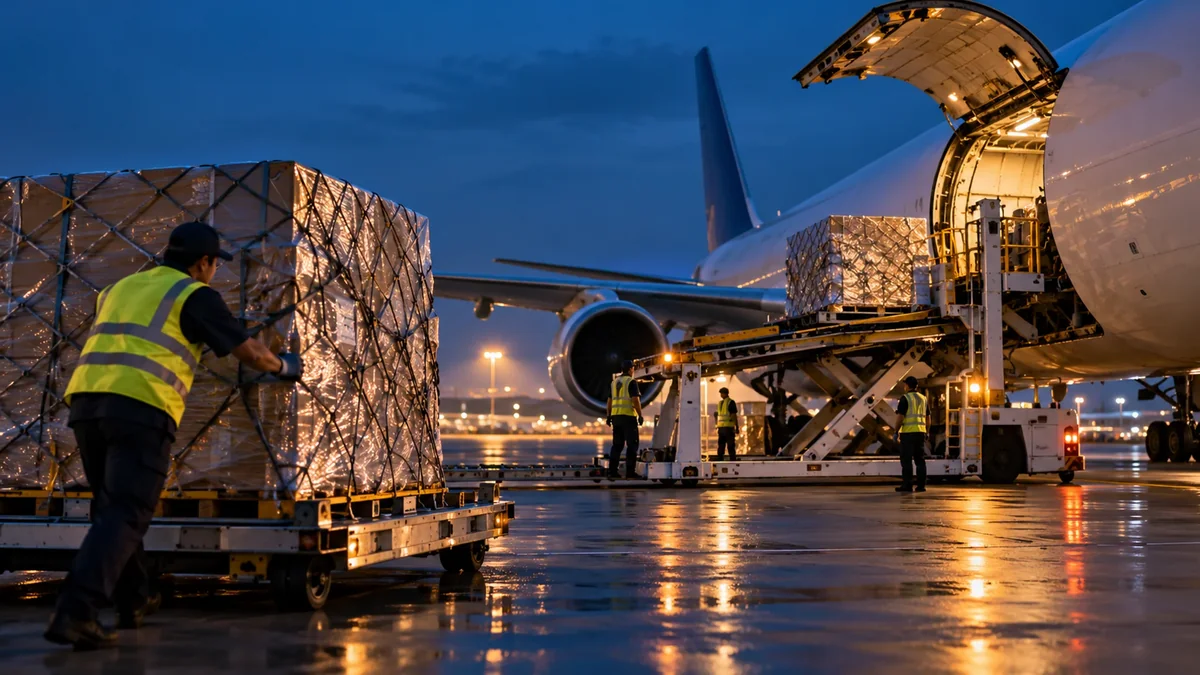
The fastest available movement is the service that reaches the consignee's required event earliest with acceptable risk. It may involve express, priority air cargo, a different departure gateway or a split shipment, and the comparison should include customs readiness.
Illustrative planning case, not a booked DDP Atlas shipment. A distributor urgently needs a small portion of a replenishment order to prevent a production stop. Split-shipping that critical quantity by expedited air and moving the balance by sea could protect operations without paying for premium uplift on the entire purchase.
Milestone data that shapes fastest-option planning
| Priority | Evidence or input |
|---|---|
| 1 | Critical quantity vs full order |
| 2 | Hard delivery deadline |
| 3 | Earliest handover |
| 4 | Priority service availability |
| 5 | Destination customs setup |
| 6 | Split-shipment economics |
How to plan urgent uplift
For fastest air freight from China, build the schedule backward from the required delivery date. Reserve time for supplier completion, pickup, receiving, export formalities, security/airline acceptance and the applicable cut-off. After uplift, include any transfer, import clearance, terminal recovery and final-mile appointment.
Urgency triage
Define the latest acceptable delivery time and the financial consequence of missing it before selecting premium service.
For fastest air freight from China, build the schedule backward from the required delivery date. Reserve time for supplier completion, pickup, receiving, export formalities, security/airline acceptance and the applicable cut-off. After uplift, include any transfer, import clearance, terminal recovery and final-mile appointment.
This milestone model makes trade-offs visible. A direct flight may save a transfer but depart less frequently; a connecting option may leave earlier but add handling risk. Door-to-door control can remove coordination gaps, but only if the consignee and customs file are ready before arrival.
Illustrative planning case, not a booked DDP Atlas shipment. A distributor urgently needs a small portion of a replenishment order to prevent a production stop. Split-shipping that critical quantity by expedited air and moving the balance by sea could protect operations without paying for premium uplift on the entire purchase.
Key takeaways
- The fastest practical route often combines a ready cargo file, local pickup discipline, a gateway with reliable uplift and a direct or low-transfer service.
- Urgent freight should be pre-screened for batteries, dimensions, piece weight and destination constraints before a premium route is booked.
- A premium flight is wasted if the importer cannot clear or receive the cargo promptly after arrival.
- Plan from cargo-ready date to required-delivery date, not from scheduled flight time alone.
- Distinguish direct uplift from connecting routings and door delivery.
The decision in one table
| Decision point | What to check |
|---|---|
| Cargo ready | Confirm when freight is packed, labelled, documented and collectible. |
| Cut-off | Work backward from warehouse and airline acceptance deadlines. |
| Routing | Compare direct uplift, connections and frequency, not scheduled flight time alone. |
| Arrival | Prepare customs and delivery before landing so the air-time advantage is not lost. |
Information to send for fastest-option planning
- Confirmed cargo-ready date, not an estimated production date.
- Pickup city and warehouse-receiving requirement.
- Required delivery date and what happens if it is missed.
- Direct-flight preference or tolerance for connections.
- Customs broker/consignee readiness at destination.
- Final delivery address and appointment or warehouse cut-off.
Planning example: fastest-option planning
A production line needs one replacement module. The team prioritizes the earliest feasible cargo acceptance, direct/fast uplift and pre-arranged destination clearance instead of spending hours negotiating a small rate difference.
Frequently asked questions
Does air-freight transit time mean flight time?
No. Importers should plan the full chain from cargo readiness and pickup through export handling, uplift, customs and final delivery.
Is a direct flight always the best option?
Not always. Direct service reduces transfers, but frequency, price, capacity and final delivery can make a connecting route more practical.
How can an importer protect an urgent deadline?
Provide final cargo data early, use a realistic cut-off buffer, pre-clear document issues and agree an alternate routing or split-shipment plan before the deadline becomes critical.
Before you book fastest air freight from China: Separate flight time from total door-to-door time, and confirm the assumption you are relying on before the cargo-ready date. The shared operating sequence and pre-booking checklist live on the Air Freight from China hub.
Where fastest-option planning goes wrong
Where importers lose time or money. Risk 1: Cargo misses warehouse or airline cut-off. Risk 2: A connection misconnects or a direct service is unavailable on the required date. Risk 3: Customs/broker data is incomplete before arrival. Risk 4: Final delivery appointment is not available when cargo clears.
Buyer control matrix.
What “fastest” can and cannot buy
Speed in air freight is bought in two different currencies: the flight and everything around it. The fastest option is the one that shortens the whole journey, which is rarely the same as the option with the shortest flight.
- A later cut-off is worth more than a faster flight when the constraint is cargo readiness. If the goods cannot be ready in time for the early flight, the early flight does not exist.
- A direct service removes an exposure, not just hours. On a tight deadline, removing the chance of a missed connection is often worth more than the difference in flying time.
- The destination leg is part of the promise. A flight that lands at a hub far from the consignee does not get to a fast delivery on its own. The arrival airport should be chosen from the delivery address, not from the flight schedule.
- Priority status changes the floor, not the ceiling. Where a shipment can be given a higher boarding priority, it is less exposed to being the consignment that gets left behind when the flight is over-booked. It does not remove weather or mechanical delay.
- Screening sits in front of the cut-off. A commodity that needs additional screening has to be at the terminal earlier, which shortens the fastest option the shipment can actually use.
So the honest version of “fastest” is a set of questions rather than a service name: what is the latest cut-off the shipment can physically make, what is the earliest flight that accepts this cargo and packaging, and what has to happen at the destination before the consignee has the goods. The answer that satisfies all three is the fastest shipment, whatever the airline’s schedule says.
Related guides
Fastest Air Freight Options from China for Urgent Commercial Cargo continues the Air Freight from China hub.
- Air Freight Transit Times from China: Direct Connecting & Door Delivery
- Air Freight Cut-Off Times and Cargo Ready Dates in China
- Air Freight Transit Time from China: Airport and Door-to-Door Planning
Guides that continue from Fastest Air Freight Options from China for Urgent Commercial Cargo:
Operational verification: airline acceptance, dangerous-goods rules, battery requirements, customs procedures, schedules, capacity and charges can change. Confirm current requirements for the actual cargo, carrier, route and booking date.
Related air-freight guidance.
Use these links to move up the cluster or compare the most relevant sibling decision.