
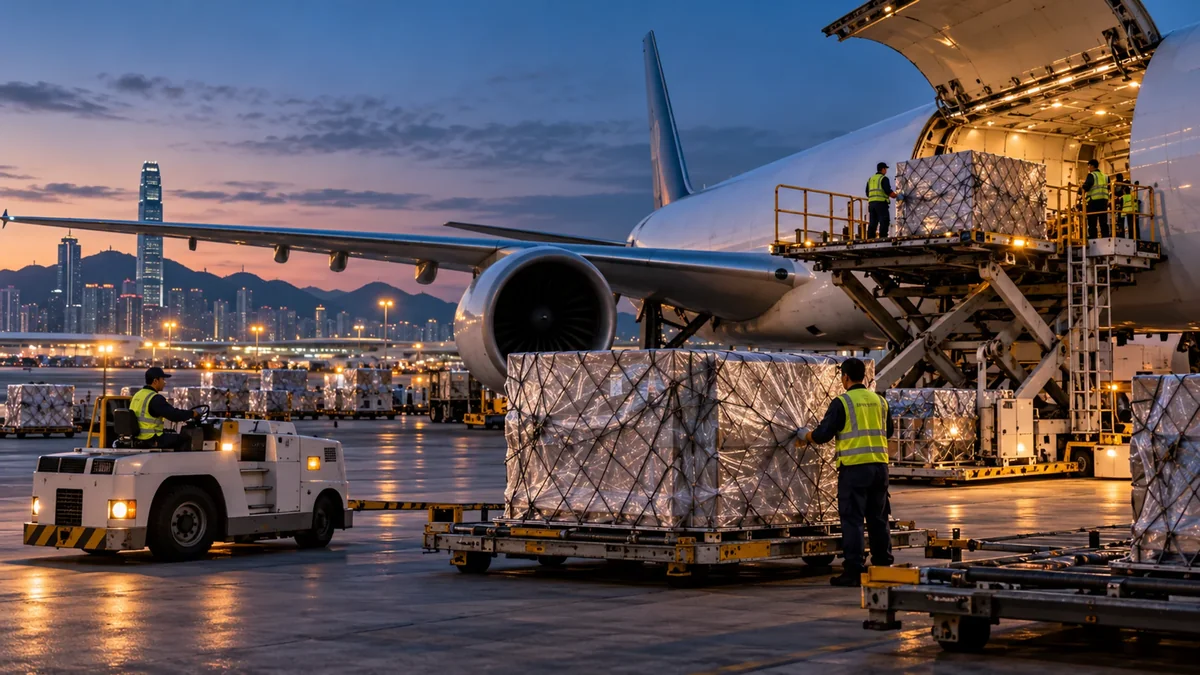
Hong Kong International Airport (HKG) can offer international cargo routing options for South China supply chains, but moving goods from mainland China to Hong Kong adds a separate cross-border execution layer. The importer must understand who owns that handover.
Illustrative planning case, not a booked DDP Atlas shipment. A Shenzhen manufacturer can deliver to a local receiving point, but the chosen air product leaves Hong Kong. Confirm whether the quote includes the border leg, documentation coordination and possible inspection delay before accepting the routing.
What to confirm before booking via the Hong Kong HKG option
| Priority | Evidence or input |
|---|---|
| 1 | Mainland supplier pickup |
| 2 | Export and border documents |
| 3 | Hong Kong receiving address |
| 4 | Cross-border trucking scope |
| 5 | HKG airline acceptance |
| 6 | Destination customs plan |
When Hong Kong International Airport (HKG) is likely to fit
This gateway is most attractive when the origin geography and available uplift work together. For Hong Kong plus eligible cross-border South China cargo, the buyer should compare same-day or next-day trucking feasibility, warehouse/terminal receiving hours and whether the planned flight can accept the cargo profile. HKG can be attractive where its network and cargo infrastructure outweigh the added cross-border transfer from mainland China.
Cross-boundary gateway logic
HKG planning must include the mainland-to-Hong Kong transfer and its documentation/operational handoff.
This gateway is most attractive when the origin geography and available uplift work together. For Hong Kong plus eligible cross-border South China cargo, the buyer should compare same-day or next-day trucking feasibility, warehouse/terminal receiving hours and whether the planned flight can accept the cargo profile. HKG can be attractive where its network and cargo infrastructure outweigh the added cross-border transfer from mainland China.
When another gateway may be better
A different gateway may win when it has materially better frequency, direct uplift, freighter capability, special-cargo acceptance or recovery options. That is why DDP Atlas should keep gateway selection dynamic rather than publishing a permanent “best airport” rule. The commercial comparison should include any extra domestic trucking created by the alternate airport.
Origin-control checklist
Before pickup, confirm the airport code, flight/routing assumption, latest cargo acceptance time, warehouse address, document cut-off and the fallback gateway. For unusual cargo, obtain acceptance before the truck leaves the supplier.
Illustrative planning case, not a booked DDP Atlas shipment. A Shenzhen manufacturer can deliver to a local receiving point, but the chosen air product leaves Hong Kong. Confirm whether the quote includes the border leg, documentation coordination and possible inspection delay before accepting the routing.
Key takeaways
- Hong Kong International Airport (HKG) serves Hong Kong plus eligible cross-border South China cargo. HKG can be attractive where its network and cargo infrastructure outweigh the added cross-border transfer from mainland China.
- Typical cargo evaluated through this gateway includes high-value electronics, time-sensitive cargo, e-commerce and broad international air cargo, subject to airline and handling acceptance.
- Before booking, compare cross-border trucking, export/import handoff, cargo eligibility, documentation and schedule advantage versus mainland gateways.
- Compare total origin-to-destination performance rather than airport distance alone.
- Keep alternate gateways available for peak periods or special cargo.
The decision in one table
| Decision point | What to check |
|---|---|
| Origin trucking | Compare supplier-to-airport time, cost and cut-off. |
| Uplift options | Check current direct/connecting services and frequency. |
| Cargo fit | Confirm piece dimensions, weight and special-cargo acceptance. |
| Destination result | Choose the gateway that produces the best end-to-end delivery, not just the shortest China trucking leg. |
How to plan the Hong Kong HKG option
Hong Kong International Airport (HKG) should be evaluated as part of an origin network, not in isolation. For cargo from Hong Kong plus eligible cross-border South China cargo, compare the trucking window to the terminal, available uplift, cargo acceptance and the destination result. HKG can be attractive where its network and cargo infrastructure outweigh the added cross-border transfer from mainland China.
Cargo such as high-value electronics, time-sensitive cargo, e-commerce and broad international air cargo can be suitable when accepted by the planned carrier/handler. The operational comparison should include cross-border trucking, export/import handoff, cargo eligibility, documentation and schedule advantage versus mainland gateways. For time-sensitive freight, a farther airport with better uplift can outperform the geographically nearest airport.
Information to send for the Hong Kong HKG option
- Supplier pickup address and cargo-ready date.
- Piece count, piece dimensions and weight.
- Destination airport/city and delivery address.
- Cargo characteristics that can affect acceptance.
- Required delivery date and acceptable connection risk.
- Whether alternate China gateways can be considered.
Planning example: the Hong Kong HKG option
A high-value electronics shipment from South China can use HKG only if the cross-border handoff, export arrangements, cargo acceptance and schedule advantage justify the added transfer. The route decision includes that border/origin leg.
Gateway profile: Hong Kong International Airport (HKG)
Origin region: Hong Kong plus eligible cross-border South China cargo. Cargo commonly evaluated: high-value electronics, time-sensitive cargo, e-commerce and broad international air cargo. Strategic fit: HKG can be attractive where its network and cargo infrastructure outweigh the added cross-border transfer from mainland China.
The final booking should confirm cross-border trucking, export/import handoff, cargo eligibility, documentation and schedule advantage versus mainland gateways. This is deliberately written as a decision requirement rather than a permanent schedule claim because airline products and capacity change.
Where the Hong Kong HKG option goes wrong
Where importers lose time or money. Risk 1: Cargo is trucked to a gateway before airline acceptance is confirmed. Risk 2: The selected airport has fewer suitable uplifts than an alternative gateway. Risk 3: Cross-city or cross-border transfer consumes the schedule advantage. Risk 4: Special cargo or oversized pieces are incompatible with the planned flight.
Buyer control matrix.
Hong Kong International Airport (HKG) at a glance
| Item | Value |
|---|---|
| IATA code | HKG |
| ICAO code | VHHH |
| Airport | Hong Kong International Airport |
| Service city / market | Hong Kong SAR, China |
| ICAO aerodrome reference code | 4F |
| Sourcing region served | Hong Kong SAR, China, with cross-border feeder trucking from the Pearl River Delta |
What the HKG code tells you, and what it does not
HKG is a separate customs territory from the Chinese mainland. Cargo sourced on the mainland and exported through HKG therefore crosses a border, which adds a customs and vehicle-transfer step at the land boundary that does not exist when the same cargo departs from SZX or CAN. That extra step is the main thing to price and schedule, and it is why HKG is normally compared against mainland gateways rather than assumed.
HKG is a separate customs territory from the Chinese mainland. Cargo sourced on the mainland and exported through HKG therefore crosses a border, which adds a customs and vehicle-transfer step at the land boundary that does not exist when the same cargo departs from SZX or CAN. That extra step is the main thing to price and schedule, and it is why HKG is normally compared against mainland gateways rather than assumed.
Related guides
Hong Kong HKG Air Freight for China Cargo: When the Gateway Fits continues the Air Freight from China hub.
- China Air Cargo Airports: Export Gateways for Air Freight
- Guangzhou CAN Air Freight: South China Cargo Gateway Guide
- Beijing PEK Air Freight: North China Cargo Gateway Guide
- Shanghai PVG Air Freight: Export Gateway Guide
Guides that continue from Hong Kong HKG Air Freight for China Cargo: When the Gateway Fits:
Operational verification: airline acceptance, dangerous-goods rules, battery requirements, customs procedures, schedules, capacity and charges can change. Confirm current requirements for the actual cargo, carrier, route and booking date.
Related air-freight guidance.
Use these links to move up the cluster or compare the most relevant sibling decision.