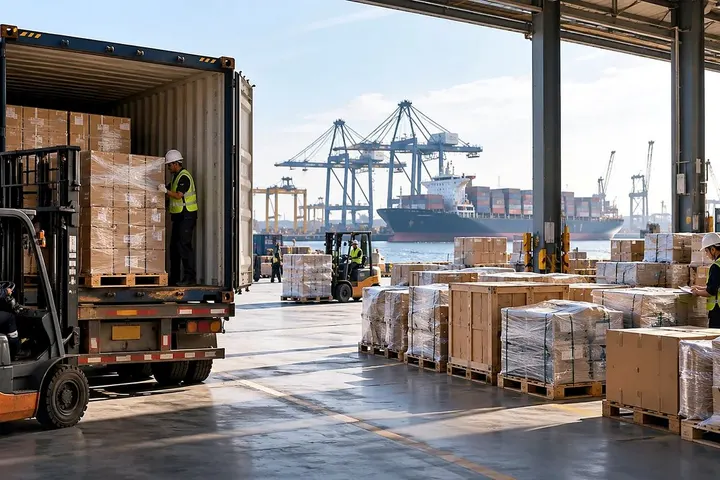
Pallet Shipping from China to the UK: Start With the Unit Load
Pallet shipping from China to the UK is often described as if the freight price were simply “one pallet to London.” For commercial imports that is rarely the full picture. A pallet is a handling unit, while the chargeable freight depends on the pallet's packed dimensions, gross weight, stackability, selected transport mode, origin handling, destination CFS or terminal processes, UK customs and final delivery access.
An importer bringing retail display units, packaged housewares or wholesale cartons into the UK needs a quote that covers the pallet as shipped and the business address where it will be unloaded. This guide addresses planned B2B cargo moving from Chinese suppliers to Great Britain. Rules for Northern Ireland, regulated commodities and specific packaging materials may differ. It does not provide fixed live LCL or duty prices.
What Is the Difference Between a Pallet and an LCL Shipment?
A pallet is a load platform or unitization method. LCL (less-than-container-load) is an ocean shipping arrangement in which cargo from multiple customers is consolidated into shared container capacity. An LCL shipment may include cartons, crates, palletized goods or other permitted packaging. One pallet does not automatically mean “one cubic metre,” and not every pallet should be shipped through LCL.
Some suppliers hand over loose cartons. A forwarder or China warehouse may then palletize them. That increases handling efficiency and may improve cargo protection, but it also adds pallet dimensions, packaging weight, wrap and strapping and potentially a higher cubic volume. Whether to palletize at origin, at a consolidation warehouse or after UK import depends on the cargo and the receiving facility.
|
Term |
Practical meaning |
Buyer question |
|---|---|---|
|
Pallet |
Physical load platform under packed freight |
What are final height, footprint, weight and construction? |
|
LCL |
Shared-container ocean movement |
What minimum volume, CFS charges and destination fees apply? |
|
FCL |
Dedicated container booking |
Is total cargo volume or handling risk sufficient to justify it? |
|
CBM |
Cubic metres based on packed external size |
Are pallet overhang and height included? |
|
Stackable |
Can another unit be placed on top safely |
Is stacking allowed, and what load limit applies? |
|
Tail-lift delivery |
Vehicle unloading support without suitable dock equipment |
Does the UK site need one, and can the pallet be safely handled? |
How to Calculate Pallet CBM Correctly
Measure the external loaded dimensions, not the empty pallet or product cartons alone. Use metres:
Loaded length (m) × loaded width (m) × loaded height (m) = pallet CBM
Illustrative example: a load with final external dimensions of 1.20 m × 1.00 m × 1.50 m occupies 1.80 CBM. If the loaded height becomes 1.80 m after extra cartons and protective wrapping, the same footprint becomes 2.16 CBM—an increase of 20%. This change can affect an LCL quotation even when the number of pallets stays the same.
The example dimensions are for teaching the calculation, not a standard UK pallet specification or freight tariff. LCL pricing can also involve minimum billable CBM, weight/measurement rules and local handling fees, so a carrier's invoiced charge is not automatically identical to measured CBM. Ask the freight team to confirm the applicable basis.
For air or express shipments, calculate chargeable dimensional weight under the particular carrier divisor instead. Use DDP Atlas's volumetric weight calculator when comparing methods.
UK Pallet Sizes, Load Safety and Delivery Constraints
Different pallet footprints appear in international trade, and a UK warehouse may have its own acceptance standard. Before the shipment leaves China, confirm the delivery site's permitted pallet width, length, maximum height, individual pallet weight, fork entry, access hours and unloading equipment. A load that fits a container can still be inappropriate for a small retail receiving bay.
For fragile or irregularly packed cartons, assess compression risk and load stability. Use proper corner protection, suitable stretch-wrap tension and appropriate strapping. Avoid unstable overhang or top-heavy loads. If mixed products share a pallet, carton labels and packing details must allow the importer to reconcile individual SKUs after receipt.
Do not declare cargo “stackable” just to obtain a lower LCL price. Another pallet might be placed above it during movement. Incorrect stackability information can lead to damage or extra handling, and the freight provider may need to change how it consolidates the load.
ISPM 15: An Essential Wood-Packaging Check
Great Britain requires many solid-wood packaging materials entering from overseas—including standard solid-wood pallets, crates and certain dunnage—to comply with ISPM 15 treatment and marking requirements. Untreated or incorrectly marked solid-wood material can trigger border intervention. Some processed wood and other exempt materials are treated differently; material and construction determine applicability.
UK government guidance explains which wood packaging is covered, marking expectations and exemptions: Wood packaging material for import and export. Tell the Chinese supplier to verify compliance and use legible required marks. Do not assume that a photo of a plain wooden pallet proves conformity, or that an ordinary supplier invoice substitutes for the required packaging treatment mark.
If pallets are built at a consolidation warehouse, that warehouse must also apply the correct packaging standard. Record pallet type and packaging compliance in the pre-shipment checklist rather than treating it as an issue to discover only after arrival in the UK.
LCL, FCL and Air: Cost Comparison by Shipment Profile
|
Shipment profile |
Option to investigate |
Hidden variable |
|---|---|---|
|
One or two compact pallets, flexible deadline |
LCL |
Origin/destination CFS minimums and final-mile handling |
|
Several pallets, frequent orders |
LCL vs FCL |
Total handling and opportunity to consolidate |
|
High-value, urgent, manageable-size load |
Air freight |
Chargeable weight and airport delivery fees |
|
Larger pallet count with predictable supply |
FCL |
Container load plan, drayage, unloading and demurrage risk |
|
Mixed suppliers and destination SKUs |
China consolidation + appropriate mode |
Receiving, sorting, labeling and inventory accuracy |
A low ocean base rate can be offset by CFS devanning, handling, customs clearance, waiting charges and a tail-lift delivery. Conversely, a dedicated FCL can carry unnecessary capacity and unloading complexity for modest volume. Compare the same warehouse endpoint and the same customs arrangement.
See the sea freight service for LCL/FCL planning and the China to UK route guide for the wider UK import workflow.
What Should a Pallet Shipping Quote Include?
For a useful comparison, request separate origin, international and destination service lines.
|
Cost/handling line |
Scope to confirm |
|---|---|
|
China factory collection |
Exact pickup, access restrictions and loading responsibility |
|
Palletization |
Who supplies compliant pallets, wrap, edge protection and labels |
|
Consolidation warehouse |
Receiving, storage, remeasurement and documentation |
|
Ocean freight |
LCL chargeable basis, minimum, sailing assumptions and surcharges |
|
Destination CFS/port |
Devanning, handling, storage free time and release charges |
|
UK entry |
Broker, commodity codes, duty, import VAT and inspection contingencies |
|
Last mile |
Postcode, vehicle, unloading, delivery appointment and POD |
|
Insurance |
Optional cargo insurance, exclusions and insured amount |
Do not assume “DDP” equals “everything included no matter what happens.” DDP has an Incoterms meaning when used correctly in the commercial contract, but the quote still needs a lawful importer structure, accurate declared value and explicit handling of exceptional charges. Verify the seller's ability to perform the import-related obligations and distinguish product compliance from freight services.
UK Customs for Palletized Goods
A pallet is not a customs classification. UK import declarations classify the goods on the pallet, using the correct commodity codes, customs values, origins and any product-specific authorizations. If a single pallet contains six types of goods, a declaration may need different tariff lines for them. “General merchandise, one pallet” is not an adequate product description.
Great Britain importers generally need a GB EORI and an appropriate customs declaration. Customs Duty and import VAT depend on the import specifics, while VAT-registered businesses may qualify for postponed VAT accounting if applicable conditions are met and instructions are correctly communicated to their customs agent.
For official details, use Import goods into the UK, Find commodity codes and Postponed VAT accounting. Do not assume that sending goods through an EU port or changing pallet type changes the legal origin of merchandise.
Warehouse Delivery: The Last 20 Metres Can Cause the Most Delay
A UK receiving address may be a national distribution center, a retailer's back-of-shop goods door, an industrial estate without a loading dock or an Amazon-related prep warehouse. Each location has different vehicle access, appointment windows and equipment. Before approving the quote, confirm:
- Whether an articulated truck can access the site or a smaller vehicle is required.
- Whether a loading dock, forklift or pallet truck is provided by the consignee.
- Whether a tail-lift is needed and suitable for the loaded pallet's weight and dimensions.
- Whether delivery requires a pre-booked appointment or specific reference numbers.
- Whether a pallet exchange, waste-pallet collection or unloading service is expected.
- The maximum waiting time and who pays detention or failed-delivery charges.
- Proof-of-delivery requirements, including quantity and visible damage notes.
When the consignee cannot unload the proposed unit safely, arrange an appropriate alternative before freight reaches the final carrier. The last-mile quote may need a different vehicle or palletization plan.
Scenario: Three Pallets to a UK Retail Distributor
Illustrative operating scenario, not an actual shipment: A buyer orders display packaging from one factory and household goods from another. Supplier A produces two pallets while Supplier B produces one. The inventory must arrive together at a Nottingham distribution site with a booked unloading slot.
A useful plan is not simply “ship three pallets LCL.” It should first establish: Are the three loaded pallets stable and ISPM 15 compliant where required? Can the supplier ready dates be aligned without costly storage? Are the goods on separate invoice lines with accurate UK classifications? What is the total measured CBM? Can the consignee unload the vehicle that will actually deliver them? Is LCL still the best choice once UK destination and final-mile fees are known?
The result might be one consolidated LCL shipment, but only a current quote with the correct dimensions and destination can validate that decision.
Pre-Dispatch Pallet Inspection Checklist
- Photograph all sides and the loaded top of each pallet before shrink-wrapping is finalized.
- Record actual external length, width, height and gross weight of each loaded unit.
- Confirm pallet material, ISPM 15 requirements and legible marks if solid wood is used.
- Check stability, no hazardous overhang and truthful stackability declarations.
- Match carton and pallet identifiers to the final commercial invoice and packing list.
- Identify fragile, controlled, battery-containing or other specially handled items.
- Check the planned UK importer, tariff lines, clearance agent and delivery postcode.
- Confirm the receiving business's unloading capabilities and appointment procedure.
- Approve quotation inclusions, insurance selection and storage/exception terms.
- Retain photographs, measurement records and handover confirmation for claims and reconciliation.
Pallet Handover Checklist: China Warehouse to UK Receiving Dock
A palletized consignment can pass through several handling environments: the supplier floor, a Chinese consolidation warehouse, container loading, a destination CFS, customs release and final UK truck delivery. At each handoff the same pallet should remain identifiable and mechanically safe to move. Record the pallet ID, counted cartons, gross weight, external dimensions, packaging type, photos at dispatch and any visible damage before the next party accepts custody.
Before loading in China, check forklift entry clearance, wrap condition, stacking restriction, carton overhang and center of gravity. Where wood packaging is subject to ISPM 15, verify the required marking on actual pallet units—not merely on a supplier packing-list template. If a heavy or tall pallet cannot be stacked, state this in the booking and ask whether its volume/space allocation changes the quote.
Before releasing the UK delivery, confirm whether the receiving address is a staffed warehouse, a shop, a construction site or an external 3PL. A warehouse with a loading dock may accept a standard curtainsider. A street-level business could need a tail lift, pallet truck and timed access. Some destinations cannot safely accept a very heavy pallet through a tail lift or across a sloped surface. Agree a safe unloading responsibility and check whether the vehicle can park and turn at the location.
|
Handover point |
Evidence worth retaining |
|---|---|
|
China packing completed |
Carton/pallet counts, dimensions, visible marks, photos |
|
Origin consolidation received |
Inbound receipt and discrepancy record |
|
Export loading |
Container or shipment reference, seal where applicable |
|
UK customs released |
Broker confirmation and release reference |
|
Final delivery |
Appointment, unload arrangement, signed delivery record |
A complete delivery record helps distinguish transport damage, short receipt, missed appointments and post-delivery inventory discrepancies. It also gives the importer better data for quoting future palletized shipments.
FAQ: How much does it cost to ship one pallet from China to the UK?
There is no single reliable price without the loaded dimensions, weight, origin, UK postcode, commodity, shipping mode and included customs/delivery scope. Obtain a dated LCL/air comparison with destination charges and unloading requirements itemized.
FAQ: Is LCL the same as pallet shipping?
No. LCL describes a shared-container freight mode; a pallet is a physical way to handle cargo. Palletized goods can move by LCL, FCL, air or other appropriate services.
FAQ: Does a wooden pallet need to be treated before UK import?
Covered solid-wood packaging must meet applicable ISPM 15 standards and marking rules. Verify whether the specific material qualifies for an exemption; do not assume every wood-based product is treated identically.
FAQ: Can the pallet be delivered directly to a UK shop?
Potentially, but the shipment must use a suitable vehicle and safe unloading arrangement. A tail-lift, restricted-access vehicle or booked delivery window may change the freight quote.
FAQ: Can I combine Alibaba orders from different suppliers onto one pallet?
Often a China-side warehouse can consolidate suitable goods, provided inventory counts, carton identities, handling compatibility and customs paperwork remain accurate. Consolidation costs and timing must be evaluated.
Request a Pallet-Level Quote Rather Than a Generic China–UK Rate
DDP Atlas can review China pickup and consolidation, palletized LCL/FCL freight and destination coordination for eligible business cargo. Send the loaded pallet dimensions and weight, pallet type, detailed commodities, supplier addresses, ready dates and the UK destination's postcode and unloading access. The quote will depend on the actual route, cargo compliance and service requirements.
Request a pallet freight estimate · Read China to UK route planning · See sea freight service scope
Official References and Editorial Scope
- UK Government — Wood packaging material and ISPM 15
- HMRC — Import goods into the UK
- HMRC — Commodity codes
- HMRC — Postponed VAT accounting
Editorial check: 15 October 2026. Example dimensions and business scenarios are illustrative. Verify the current tariff, shipment limitations, packaging standard and last-mile quote for each booking.
Part of the Shipping from China hub — see the wider freight planning map.