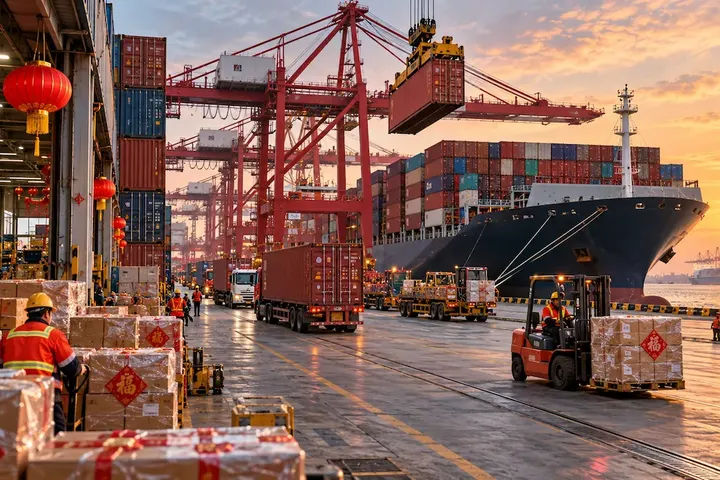
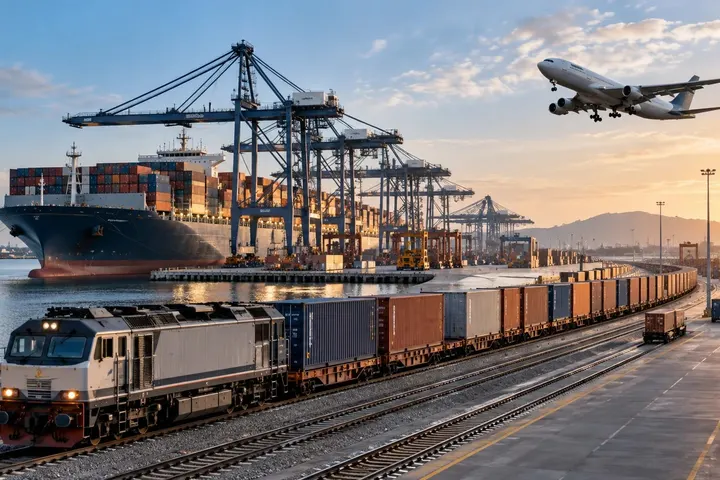
When an importer asks how long shipping from China takes, the most useful answer is not a single number. A shipment is a chain: supplier handoff, China-side pickup, warehouse receiving, export handling, main transport, customs clearance, destination handling and final delivery. A carrier may advertise a short airport-to-airport or port-to-port transit, but the buyer experiences the entire chain.
For planning purposes, treat transit time as a range with milestones, not a guarantee. The right mode depends on urgency, cargo type, shipment size, destination, customs complexity and the amount of China-side coordination required.
Typical planning ranges by shipping mode
The ranges below are broad planning estimates. Actual schedules vary by route, carrier, season, airport or port congestion, customs activity and delivery location.
| Mode | Typical use | Main-transit character | Best for |
|---|---|---|---|
| Express courier | Small urgent cartons | Fastest integrated network | Samples, documents, urgent replenishment |
| Air freight | Commercial cargo that cannot wait for sea | Fast line-haul with separate origin/destination handling | Higher-value or time-sensitive goods |
| Rail freight | Selected China–Europe corridors | Between air and sea in speed/cost | Planned European replenishment |
| Sea LCL | Smaller ocean shipments sharing a container | Slower due to consolidation/deconsolidation | Cost-sensitive cargo below FCL scale |
| Sea FCL | Full container | More direct ocean movement than LCL | Larger planned shipments |
| DDP service | A service scope rather than one transport mode | Can move by air, sea, rail or truck | Buyers wanting a defined door-to-door scope |
The key distinction is that DDP is not a speed category. A DDP shipment can travel by air or sea. When comparing two “DDP” offers, ask which transport mode, route, handoffs and destination delivery process are included.
A realistic pickup-to-delivery timeline
1. Supplier readiness
The shipment clock should start when the cargo is actually ready, not when a purchase order is issued. Before pickup, confirm:
- finished carton count;
- gross and net weight;
- carton dimensions;
- commodity description;
- declared value;
- battery, liquid, chemical or other special-cargo status;
- export documents;
- labels and marks;
- destination address and receiving requirements.
If the supplier changes the carton count or dimensions after a quote is prepared, the route and price may need to be recalculated.
2. China-side pickup and warehouse receiving
For a single supplier located near the export gateway, pickup can be straightforward. Multi-supplier shipments take longer because every supplier has a different production date, pickup location and packing standard.
A consolidation warehouse may need to:
- receive each supplier shipment;
- count cartons;
- check exterior condition;
- weigh and measure the cargo;
- identify exceptions;
- relabel or repack when required;
- combine cargo into the export shipment.
This time is not “wasted time.” It is where many avoidable international problems are found before the cargo leaves China.
3. Export booking and handoff
Air, sea and rail shipments operate around cut-off times. Missing a documentation cut-off, cargo cut-off or scheduled sailing can move the shipment to the next available departure.
For ocean freight, a buyer should distinguish:
- booking confirmation;
- empty-container release for FCL;
- cargo cut-off;
- customs cut-off;
- vessel departure;
- transshipment, if any;
- arrival at destination port.
For air freight, distinguish warehouse acceptance from the actual flight departure. Cargo can be received by an airline handling terminal before it physically departs.
4. Main transit
The international leg is usually the most visible part of the shipment, but not always the most unpredictable. Direct services are generally easier to plan than services with multiple connections.
Factors affecting main transit include:
- direct vs connecting service;
- vessel blank sailings;
- port rotation changes;
- flight space;
- weather;
- labor disruption;
- peak-season capacity;
- security screening;
- cargo restrictions;
- carrier schedule changes.
A good freight plan therefore includes a reasonable buffer, especially when stockout risk is expensive.
5. Customs clearance
Customs can clear routine cargo quickly when the classification, value, importer information and supporting documents are consistent. Delays become more likely when the shipment requires additional documents, a physical inspection, agency review or a correction.
Importers should prepare before departure, not after arrival. At minimum, the commercial invoice, packing list, shipment details, commodity description and tariff classification should tell the same story.
6. Final-mile delivery
“Arrived in the destination country” does not mean “delivered.”
Final delivery can require:
- deconsolidation;
- terminal release;
- customs release;
- appointment booking;
- pallet delivery;
- liftgate service;
- limited-access delivery;
- residential service;
- fulfillment-center appointment;
- remote-area line haul.
For B2B cargo, receiving hours and appointment rules can add more time than the local driving distance suggests.
What usually makes a shipment slower?
Supplier cargo is not really ready
A factory may say the order is finished while export cartons, labels or final quantities are still being prepared. Confirm the physical cargo status.
Dimensions or weight change
A quote based on preliminary packing data may no longer fit the original route once the actual cargo is measured.
Multiple suppliers do not finish together
Consolidation reduces duplicated freight handling, but it requires a controlled cut-off. If one supplier is late, the importer must decide whether to wait or split the shipment.
Documents do not match
Different descriptions, values, quantities or importer details across documents can trigger questions and manual review.
A shipment misses a cut-off
A few hours at origin can translate into several days if the next sailing or flight has limited capacity.
Destination delivery is not preplanned
Commercial receivers may require an appointment, dock, pallet configuration or specific receiving hours. These requirements should be collected before the cargo arrives.
How to choose the right mode by business need
Use express when the cost of waiting is higher than the freight premium
Examples include sales samples, replacement components or a few urgent cartons.
Use air freight when inventory is time-sensitive but shipment size is commercial
Air can be more economical than repeated express shipments once volume grows, depending on chargeable weight and destination handling.
Use sea freight when the shipment can be planned around inventory
Ocean freight rewards forecasting. FCL is often operationally cleaner for larger shipments; LCL is useful when a full container is not justified.
Use rail for suitable China–Europe lanes when the service fits the cargo
Rail can provide a useful middle option, but route availability, border handling and final delivery should be checked for the exact shipment.
A better way to ask for a transit-time quote
Instead of asking, “How many days to my country?”, send:
- pickup city in China;
- destination postcode;
- commodity;
- cartons;
- gross weight;
- carton dimensions or CBM;
- cargo-ready date;
- Incoterm with the supplier;
- requested service level;
- receiving restrictions.
Then ask the forwarder to separate:
China pickup → warehouse → export departure → international transit → customs → final delivery.
That gives you a plan you can manage.
Shipping-time planning checklist
Before you commit to a delivery promise, confirm:
- cargo-ready date is realistic;
- final carton data is available;
- special-cargo status is declared;
- export documents are ready;
- route and transport mode are identified;
- departure is confirmed, not assumed;
- importer/customs information is prepared;
- destination delivery requirements are known;
- peak-season buffer is included;
- shipment milestones will be tracked.
FAQ
Is DDP always faster than normal freight?
No. DDP describes responsibility and delivery scope, not the physical speed of the transport mode. DDP can move by air, sea, rail or another route.
Is port-to-port transit the same as total shipping time?
No. Total time includes origin pickup, export handling, customs, destination handling and final delivery.
Why does LCL often take longer than FCL?
LCL requires consolidation before departure and deconsolidation after arrival. Those extra handling stages can add time.
Should I choose the fastest route for every shipment?
Usually not. A better strategy is to match freight speed to inventory risk: urgent replenishment by air, planned inventory by sea, and split shipments when the economics support it.
Plan the whole shipment, not just the main transit
The useful question is not simply “How fast is the vessel or flight?” It is: When can this cargo realistically move from the supplier in China to the final receiving point?
DDP Atlas coordinates China-side pickup, warehouse receiving, consolidation, international freight, customs coordination and destination delivery so importers can work from one connected shipment plan.
Next step: prepare the final carton count, total weight, dimensions, cargo type and destination postcode, then request a route review or freight estimate.
Related planning resources: Compare air freight, sea freight and rail freight from China, review DDP shipping, or request a planning freight estimate.
Part of the Shipping from China hub — see the wider freight planning map.