
Shipping from China to Singapore: Sea Freight, Air Freight & DDP Guide
Compare sea, air, LCL, FCL and eligible DDP shipping from China to Singapore: what an honest quote includes, China gateways and Singapore port/air arrival, Singapore Customs, TradeNet, UEN, the 9% GST, dutiable goods and coordinated door delivery.
Choose the mode around timing, volume and delivery scope.
Do not compare route prices without also comparing what is included. Pickup, customs coordination, destination handling and final delivery can change the real operating cost.
Transit depends on route
Dedicated container loads and tighter loading control
Check an estimate →Transit depends on route
Smaller shared-consol shipments below FCL volume
Check an estimate →Build the quote around the real shipment.
Route selection becomes more reliable when the forwarder has the delivery geography and cargo data at the beginning.
Accurate dimensions matter before you compare rates.
Light but bulky cargo can be priced on volumetric weight. Large sea-freight shipments should also be reviewed by CBM, pallets and container utilization rather than kilograms alone.
Country freight guide · China → Singapore · Updated October 2026
Moving goods from a Chinese factory to a Singapore warehouse can be relatively straightforward—until a shipping quote excludes destination handling, the cargo needs a controlled-goods approval, or the buyer assumes that “DDP” automatically solves importer-registration requirements. A reliable shipment starts with the cargo and its commercial destination, not a generic per-kilogram figure.
This guide explains how to choose sea freight, air freight or express delivery from China to Singapore; how full-container (FCL) and less-than-container-load (LCL) shipments are billed; which Singapore Customs and TradeNet requirements matter; how the prevailing 9% Goods and Services Tax (GST) fits into landed cost; and which details to request before accepting a door-to-door quotation. It is intended for commercial importers, procurement teams, e-commerce merchants and brands managing repeat replenishment.
Planning a shipment? Request a China–Singapore freight quote. Share your pickup city, final Singapore delivery location, cargo description, total weight, CBM and required delivery date. DDP Atlas will review the service scope and available options before providing a shipment-specific quote; availability, pricing and transit are not guaranteed by this guide.
Shipping from China to Singapore at a Glance
|
Buyer question |
Practical answer |
|---|---|
|
What freight modes should I compare? |
Ocean FCL, ocean LCL, air cargo and express courier; consider door delivery separately from the international leg. |
|
Where does ocean cargo usually arrive? |
Singapore is a major maritime gateway; terminal and final release location depend on carrier and booking. PSA container facilities and Jurong Port handle different cargo profiles. |
|
Which airport handles air cargo? |
Singapore Changi Airport (SIN), subject to actual carrier itinerary, cargo acceptance and handling arrangements. |
|
Is import GST payable? |
The prevailing standard GST rate is 9%. Actual import treatment, exemptions and valuation depend on the shipment and importer. |
|
How are commercial imports declared? |
Generally through a Singapore Customs import permit via TradeNet, filed by the registered importer or appointed declaring agent, subject to the applicable exceptions and schemes. |
|
Are all products subject to customs duty? |
No. Singapore lists four broad groups of dutiable goods: intoxicating liquor, tobacco products, motor vehicles and petroleum products. Many other products are non-dutiable but can still attract import GST. |
|
Can I get an accurate live rate from this page? |
No automatic live rate is asserted. A valid quote requires origin, cargo measurements, commodity, service scope and current capacity/rate confirmation. |
|
What should I confirm before booking? |
Named pickup/delivery points, importer of record, permitted commodity, Incoterm, chargeable measurement, inclusions, exclusions, validity and shipment milestones. |
Singapore's port system is a substantial international trade hub. The Maritime and Port Authority (MPA) reported 44.66 million TEUs of container throughput in 2025. This is context for the market, not evidence of a specific China–Singapore sailing schedule, a guaranteed transit time, or an offered rate. Source: MPA, January 2026.
Choose the Right Freight Option: Sea, Air or Express
The right mode depends on total packed volume, cargo density, shipment urgency, receiving constraints and whether the consignee needs port/airport handoff or a fully coordinated delivery. Importers should compare the total delivered scope instead of selecting the lowest visible line-haul rate.
|
Service |
Best suited to |
Typical charging logic |
Key questions |
|---|---|---|---|
|
Ocean FCL |
A shipment that warrants dedicated container capacity or requires tighter loading control |
Container equipment, origin/destination pair, sailing, local charges, inland movement |
Which container size? What is included at both ends? Who bears free-time, detention, demurrage and unloading risks? |
|
Ocean LCL |
Cargo below a practical full-container quantity, including multi-supplier consolidations |
Chargeable W/M (weight or measurement), minimums and local CFS charges |
What are the minimum charges, consolidation/deconsolidation charges and destination release fees? |
|
Standard air freight |
Time-sensitive inventory, valuable or compact cargo, launch replenishments |
Billable/chargeable weight, airline capacity, handling and fuel/security charges |
Actual versus dimensional weight? Direct or connecting? Airport-to-airport or door-to-door? |
|
Express courier |
Eligible sample cartons and small urgent parcels |
Carrier-specific volumetric/actual-weight rules and parcel surcharges |
Who pays import charges, and are oversize/remote-area or regulated-goods fees applicable? |
|
Coordinated door delivery |
Buyers who want one defined operational scope across the journey |
Mode plus origin, customs, destination, inland and receiving services |
What exactly is included, and is the proposed Incoterm legally and operationally workable? |
For relatively bulky, non-urgent inventory, ocean shipping is generally a sensible starting point. For a small batch needed to prevent a stockout, compare air or courier against the commercial impact of waiting. An importer may also split a purchase order: urgent SKUs by air, the balance by ocean. The best mode is often a stock-planning decision rather than a simple freight-price contest.
Do not assume that every China origin has a daily direct sailing or direct flight to Singapore. A routing through a consolidation hub, a feeder service or a connecting flight changes both cost and handoff risk. Ask your forwarder to specify the actual origin gateway and service once cargo is ready.
Shipping Costs from China to Singapore: What a Quote Must Include
A headline "USD per CBM," "USD per kg," or "USD per container" figure is not an end-to-end landed-cost comparison. Two quotations are comparable only if they cover the same commodity, packing measurements, Incoterm, pickup address, destination, customs responsibility and delivery service.
Compare line items, not marketing prices
|
Cost item |
Sea FCL |
Sea LCL |
Air freight / courier |
|---|---|---|---|
|
China factory pickup |
May be included or separate |
May be included or separate |
May be included or separate |
|
Export handling and paperwork |
Confirm loading, terminal and document fees |
Confirm consolidation/CFS/document fees |
Confirm screening, handling and documentation |
|
International freight |
Container rate and relevant surcharges |
W/M basis, minimums and surcharges |
Chargeable kg, minimums and relevant surcharges |
|
Singapore terminal / destination handling |
Confirm terminal release, equipment and local fees |
Confirm CFS/deconsolidation/release fees |
Confirm terminal, cargo recovery or courier handling |
|
Customs permit and declaring agent |
Specify responsible party and fees |
Specify responsible party and fees |
Specify responsible party and fees |
|
GST and applicable duties |
Confirm who calculates, pays and may recover GST |
Same |
Same; parcel taxation can follow additional rules |
|
Final-mile delivery |
Confirm address, truck type, access and unloading |
Same |
Confirm parcel, van or truck service and restrictions |
|
Exceptions |
Storage, inspection, delays, detention/demurrage |
Storage, remeasurement and extra handling |
Dimensional adjustment, redelivery, special cargo |
Competitor shipping rates are not presented as DDP Atlas rates. Show a numeric estimate only where an approved, unexpired Rate Card matches the origin, destination, mode, service terms, weight/CBM, commodity restrictions and all calculation conditions. Otherwise, show “Quote required — cargo-specific review.” If the website offers an estimated price, it must be conspicuously labelled as an estimate, not a confirmed booking rate.
Four questions that expose an incomplete quote
- Where does the price begin and end? Is the origin a named China factory or simply the export terminal? Is the destination a Singapore port, bonded facility, warehouse gate or fully unloaded receiving address?
- What is included at destination? A low ocean freight line can be outweighed by Singapore handling, documentation, deconsolidation, storage or truck costs.
- Who handles permits and taxes? Import GST, possible duty, declaring-agent fees and compliance support are different cost categories.
- What can change the final invoice? Ask about cargo remeasurement, carrier surcharges, inspection, revised delivery windows and quote expiration.
Example (hypothetical, not a customer case or market quotation): A Singapore apparel wholesaler asks three providers to move the same packed cartons from one Shenzhen pickup point to a warehouse in the east of Singapore. Provider A offers a low LCL ocean figure but excludes destination CFS and delivery. Provider B provides a higher stated figure covering pickup, international movement, CFS and trucking but excludes GST. Provider C offers air cargo on a chargeable-weight basis. The buyer should compare total payable scope and the required receipt date; none of the line-haul prices alone establishes the cheapest or fastest workable solution.
Request a cargo-specific quote for Singapore rather than relying on unsupported current-rate tables.
How Long Does Shipping from China to Singapore Take?
Transit-time figures are easy to misuse. A sailing time is not a door-to-door delivery commitment, and flight time is not the same as cargo-ready-to-consignee time. Departure schedules, port cutoffs, customs review, terminal availability and receiving appointments can all change the final date.
|
Milestone |
Ocean freight |
Air freight / express |
|---|---|---|
|
Supplier preparation |
Final production, packing, carton list, cargo-ready date |
Same; also confirm air acceptance and screening requirements |
|
Origin collection |
Factory pickup and warehouse/terminal transfer |
Factory pickup and airport/courier handoff |
|
Origin processing |
Consolidation, export documents, vessel cutoff and loading |
Export filing, acceptance, security screening and uplift |
|
International movement |
Booked vessel/feeder itinerary |
Booked flight(s) or courier network itinerary |
|
Arrival and import processing |
Destination terminal handling, declaration and release |
Airport/express clearance and cargo recovery |
|
Final delivery |
Truck booking, receiving hours, unloading arrangements |
Local delivery, appointment or parcel handoff |
A professional estimate should provide separate planning windows for: cargo ready → departure; departure → Singapore arrival; arrival → customs/terminal release; release → final receiving. For a current route-specific number, obtain a dated carrier itinerary and written quote. Avoid publishing a single fixed "X days" for every origin city or every service level.
What commonly causes delays?
- Cargo dimensions or gross weight change after the quotation.
- One supplier in a consolidation is late, holding the combined departure.
- Export shipping instructions miss a carrier or warehouse cutoff.
- Goods are misclassified or require an approval not secured before shipment.
- Importer, declaring-agent and invoice information do not match.
- A container's free time expires before delivery arrangements are ready.
- Receiving sites restrict truck height, loading hours, lift equipment or delivery appointments.
A useful booking request: "Please quote both port/airport arrival and final door delivery, with the named China pickup location, nominated Singapore arrival point, a realistic planning window and separate customs/tax responsibility."
FCL vs LCL: How to Choose for Singapore Imports
FCL (full container load) gives the shipment a dedicated container, although the importer may not use all available space. It can suit higher-volume cargo, fragile loads requiring controlled stowage, special loading plans and repeat purchase orders. The container booking, size, cargo weight, truck access, loading equipment and destination receiving arrangements all matter.
LCL (less than container load) combines cargo from multiple shippers within a consolidation arrangement. It can reduce the barrier to ocean shipping for smaller commercial orders, but cargo passes through CFS/consolidation and deconsolidation steps. Ask about warehouse receiving cutoffs, cargo marking, minimum charge, destination release, local delivery and liability for remeasurement. A tiny shipment can be disproportionately affected by minimum and destination fees.
|
Decision factor |
FCL |
LCL |
|---|---|---|
|
Capacity |
Dedicated container equipment |
Shared cargo space |
|
Handling interfaces |
Container loading/seal and later unloading; number of handling events depends on setup |
Typically more consolidation/deconsolidation interfaces |
|
Price transparency |
Container/route quote plus origin/destination/inland scope |
W/M freight plus origin/destination CFS and minimum charges |
|
Operational control |
Greater control of loading plans; still subject to terminal and carrier rules |
Requires coordination with consolidator cutoff and co-loaded cargo |
|
Best buyer question |
Does the complete container solution beat LCL after local costs? |
Are minimum, CFS, documentation and final delivery charges all included? |
There is no universal CBM threshold that proves FCL is cheaper: both freight and local costs vary. Request side-by-side quotes when the cargo is near an economically relevant container volume, and confirm whether the cartons can physically fit the selected equipment.
China Export Gateways and Singapore Arrival Points
The "best China port" is not necessarily the closest point on a map. It is the gateway that best matches the factory location, inland trucking, cutoffs, equipment, carrier frequency, commodity restrictions and Singapore delivery objective.
Common China origin planning regions
- Shenzhen / South China: Practical to evaluate for suppliers in Shenzhen, Dongguan, Huizhou and nearby Pearl River Delta manufacturing areas; compare the actual terminal, truck journey, sailing or air acceptance.
- Guangzhou / Pearl River Delta: Another common starting point for Guangdong suppliers; compare origin handling and service availability rather than assuming interchangeability with Shenzhen.
- Shanghai / Ningbo / Yangtze River Delta: Consider for suppliers in Shanghai, Zhejiang, Jiangsu and neighboring manufacturing regions; compare inland pickup and actual carrier service.
- Xiamen / Fuzhou and other gateways: May be relevant for particular supplier regions or carrier networks; confirm routing before naming a preferred service.
- Qingdao / Tianjin and northern gateways: Consider based on factory geography and carrier itinerary, including any transshipment or feeder legs.
These are potential planning origins, not claims that DDP Atlas has confirmed direct sailings, space or prices from each city.
Singapore sea gateways
The Maritime and Port Authority identifies PSA Corporation and Jurong Port as Singapore's two principal commercial terminal operators. The port network includes Tuas and Pasir Panjang container facilities, among other terminals; Jurong Port handles much of the conventional and bulk cargo profile. The terminal for any actual shipment is determined by carrier routing, handling arrangements and cargo type—not by choosing the most visually familiar port. MPA terminals; MPA Tuas Port development.
Singapore air gateway
Singapore Changi Airport (SIN) is the main air-cargo gateway. Changi Airport Group describes its airfreight centre and Airport Logistics Park of Singapore, including dedicated handling for express and specialized cargo. Eligibility for temperature-sensitive, dangerous, battery-powered or other sensitive goods still requires the current airline, handling agent and relevant authority's approval. Changi cargo overview.
Singapore Customs: UEN, Customs Account and TradeNet
For commercial import planning, identify the importer and filing responsibility before the cargo leaves China. The buyer, seller, freight provider and customs declaring agent cannot safely treat these as interchangeable roles.
The standard business-import process
- Confirm the importing entity. A Singapore business typically requires a Unique Entity Number (UEN), issued through ACRA or an appropriate UEN-issuing agency.
- Activate a Customs Account. The relevant declaring entity activates its account with Singapore Customs before permit applications. Singapore Customs does not charge a fee for Customs Account activation. This is distinct from possible company-registration, software or declaring-agent costs.
- Classify the goods. Confirm the Singapore HS/AHTN classification, whether the goods are controlled, the origin and any applicable approvals.
- Appoint a declaring agent or file through an authorized setup. A declaring agent can handle TradeNet submissions. Businesses filing themselves must satisfy the registration and TradeNet access requirements.
- Submit the relevant import permit through TradeNet. The declaration type depends on the goods, the purpose of import, duty/GST treatment and any relevant Customs scheme.
- Meet permit conditions and pay applicable charges. Documentation, checkpoint presentation rules, release controls and tax payment depend on how the shipment is imported and the approved permit.
Singapore Customs' import permit instructions, Customs Account guidance, and import procedures overview explain the official framework. Some low-risk, personal, postal or other exceptional movements can be treated differently; do not apply a commercial-container rule indiscriminately to every small parcel.
The importer of record is not merely an invoice label
Before agreeing to DDP or a managed door-to-door arrangement, verify the actual legal/import declaration structure. Who is named as importer? Whose UEN is used? Who authorizes the declaring agent? Who pays GST and retains proof of payment? Which entity can claim import input tax, if eligible? Does the seller have a workable arrangement to fulfill the customs obligation? An undefined importer can delay release even when freight has already arrived.
Free Trade Zones are not a blanket GST exemption
Singapore's Free Trade Zones facilitate entrepôt and transshipment operations. Singapore Customs explains that duty and GST may be suspended on goods within an FTZ, with tax treatment changing when goods enter the local customs territory for consumption or sale. A buyer should not interpret "through Singapore" or "stored in an FTZ" as automatically equivalent to tax-free domestic importation. Customs FTZ guidance.
Singapore Import GST, Duties and Landed Cost
The prevailing Singapore GST rate is 9% according to IRAS. Import GST is generally calculated using the relevant customs value plus applicable duties, with special rules for particular transaction structures, exemptions, low-value goods and approved schemes. Singapore Customs explains that customs valuation normally starts from a cost, insurance and freight (CIF) basis, with required adjustments under the applicable valuation rules. Do not treat a freight quote's commercial label “CIF” as proof of the correct taxable value without reviewing the transaction.
Official references: IRAS current GST rate, Singapore Customs GST calculation, and customs valuation methods.
Duty is not the same as GST
Singapore identifies four principal categories of dutiable goods: intoxicating liquors, tobacco products, motor vehicles and petroleum products. Many ordinary goods are non-dutiable, although import GST and compliance obligations may still apply. Classification and exemptions should be checked using official tools rather than a generic statement such as "all imports pay 9% duty." Singapore Customs duty categories.
Illustrative GST calculation — not a live import assessment
For an ordinary non-dutiable shipment where the legally accepted customs value is S$11,300, a simple illustration at the prevailing 9% rate yields S$1,017 in GST, assuming no special valuation rule or relief applies. This arithmetic example is not a quotation, not a declaration, and not advice to use that exact customs value. The actual basis can depend on transaction history, freight/insurance allocation, permitted adjustments and the identity of the declaring importer. For dutiable goods, add relevant duty to the applicable GST base as required by the rules.
An importer may be able to claim eligible input GST depending on registration, ownership, documentary and IRAS requirements; do not advertise import GST as automatically recoverable. IRAS GST overview.
Preferential tariff treatment: check the product first
Free trade agreements and origin evidence can be relevant for qualifying dutiable imports. However, a generic China-origin certificate does not automatically eliminate import GST, and most non-dutiable shipments do not gain a customs-duty saving from an FTA rate of zero. Confirm HS classification, origin rules and documentary requirements before presenting preference claims. Singapore Customs preferential tariffs.
DDP, DAP, FOB and CIF: Agree Who Does What
Incoterms® 2020 describe a commercial allocation of delivery tasks, costs and risks, but they do not replace the applicable customs law or guarantee that a particular company can act as importer in Singapore. Identify the named place precisely in the sales contract and freight proposal.
|
Trade term |
Core operational interpretation |
Singapore import question |
|---|---|---|
|
DDP — Delivered Duty Paid |
Seller bears extensive responsibility for delivering goods at the named destination and generally handles import formalities and import duties/taxes under the agreed term. |
Can the seller legally and operationally arrange the required importer/declaring entity, permits and GST payments? Is every tax and exception truly included? |
|
DAP — Delivered at Place |
Seller arranges delivery to the named place, ready for unloading; import clearance and taxes generally fall to the buyer. |
Does the Singapore buyer have a valid importer and declaring-agent arrangement ready before arrival? |
|
FOB — Free On Board |
For eligible sea/inland-waterway shipments, seller's delivery/risk transfer occurs when goods are on board the vessel at the named port of shipment. |
Has the buyer planned the main carriage, insurance, Singapore import formalities and door delivery? |
|
CIF — Cost, Insurance and Freight |
For eligible sea/inland-waterway shipments, seller pays named destination-port carriage and minimum required cargo insurance; risk normally transfers when goods are placed on board at the shipment port. |
Does the buyer understand that CIF is not door delivery and does not shift risk at the Singapore destination port? |
For containerized freight handed over before vessel loading, ask the commercial adviser whether a multimodal term such as FCA/CIP/CPT is more suitable than FOB/CIF. For air freight, avoid treating FOB/CIF as interchangeable with multimodal terms. Seek specific Incoterms/legal advice for contractual drafting. ICC Incoterms® official overview.
DDP Atlas editorial rule: never promote "tax included" unless the quoted written scope, importer arrangement and commodity eligibility substantiate it. Where DDP is not appropriate, clearly explain a lawful alternative such as DAP with importer-managed clearance, subject to the actual contract.
Controlled Goods and Singapore Import Compliance
Before collection in China, identify the correct Singapore eight-digit HS/AHTN classification and use Singapore Customs' HS/CA Product Code Checker to confirm whether the product falls under a competent authority's control. Specific foods, health products, telecom devices, chemicals, batteries, plant/animal materials and other categories may require review—but a broad product category does not prove every item requires a permit from the same agency.
|
Product scenario |
What to check before shipping |
|---|---|
|
Fashion apparel and ordinary consumer goods |
Correct product description, HS classification, labeling/consumer safety where applicable, valuation and importer records. |
|
Wi-Fi / Bluetooth / radio-enabled equipment |
Check IMDA-related requirements and the exact item/product classification; do not assume ordinary electronics are all handled identically. |
|
Food and beverage shipments |
Check Singapore Food Agency requirements by product type, origin and import purpose; temperature control and shelf-life can affect transport. |
|
Cosmetics, supplements and health-related products |
Determine whether HSA or other authority rules apply for the exact goods, claims, ingredients and commercial purpose. |
|
Lithium batteries, power banks and dangerous goods |
Check carrier/airline acceptance, battery documentation and hazardous-goods packaging before any air booking. |
|
Wood packing, pallets and dunnage |
Check destination phytosanitary conditions and applicability of ISPM 15 for raw-wood packaging; not every processed-wood packaging material is treated the same. |
The appropriate starting source is Singapore Customs Controlled and Prohibited Goods and its HS classification guidance. For packaging, consult the IPPC ISPM 15 standard. For sensitive cargo, an approved transport booking does not constitute regulatory approval to import or sell the goods.
China Supplier Pickup and Multi-Supplier Consolidation
For importers buying from several China factories, consolidation can simplify the movement to Singapore, but it creates an extra coordination step. It is most useful when suppliers deliver different SKU groups in separate batches and the buyer wants one controlled departure or a consistent receiving record.
A practical consolidation plan should identify:
- Each factory's pickup address, cargo-ready date and contact.
- Item-level PO/SKU references, invoice and packing-list data.
- Number of cartons, gross weight and final outer dimensions from actual packed goods.
- The nominated warehouse or CFS receiving cutoff and labels required for identification.
- Inspection, counting, photos or repacking requirements only where ordered and included in the service scope.
- Whether the final combined shipment is one commercial transaction or several invoices/import declarations.
- Who signs off discrepancies, damage or missing cartons before export.
Operational example (illustrative): A Singapore retail chain sources garments from one supplier in Dongguan and packaging accessories from another in Foshan. Consolidation may reduce shipment fragmentation, but it is only advantageous if the factories meet the shared cutoff and the buyer accepts the additional warehouse handling. The quotation should compare total costs and the downstream effects of a single late supplier. This is a planning scenario, not a claimed DDP Atlas customer shipment.
Where DDP Atlas offers supplier pickup or consolidation, the relevant service, inspection checks and fees should be confirmed against the actual shipment. Do not imply that all optional warehouse activities are free or automatically included.
Singapore Final Delivery: Warehouse and Receiving Checks
Reaching Singapore is not the same as completing delivery. A port release is a different milestone from a warehouse-signed receipt, and a “door-to-door” quotation can still omit unloading, tailgate/liftgate, appointment, waiting or special-access costs unless those tasks are written into the scope.
Ask the consignee to confirm:
- Full Singapore street address, postal code, consignee contact and receiving hours.
- Business, warehouse, retail store, office building, bonded location or residential destination.
- Dock height, truck-access restrictions, unloading equipment and site safety requirements.
- Palletized versus loose-carton receiving, pallet dimensions and maximum unit weight.
- Delivery appointment, proof of delivery and discrepancy reporting requirements.
- Whether goods require onward inventory sorting, relabeling or appointment at an e-commerce facility.
For FCL, the container's free time and the consignee's ability to unload promptly are particularly important. For LCL, confirm whether the destination agent will deliver pallets or loose cartons and how shortage or damage discrepancies should be documented. For air freight, identify the party responsible for cargo pickup from the handler and local dispatch to the consignee.
A delivery contract should specify a named place and practical handover point. “Singapore” alone is not a complete delivery address.
China to Singapore Shipping Documents Checklist
The following checklist is designed for pre-booking and pre-departure reviews. Actual documents vary with the goods, permit type, Incoterm, cargo mode and the parties' legal roles.
|
Document / data |
Why it matters |
Primary owner / review |
|---|---|---|
|
Commercial invoice |
Parties, currency, descriptions, quantities, unit values, origin and declared transaction |
Supplier issues; importer/declaring agent verifies |
|
Packing list |
Package count, gross/net weight, dimensions, marks and SKU/PO breakdown |
Supplier; warehouse checks against actual cargo |
|
Bill of lading or air waybill |
Transport parties, cargo details and carriage evidence |
Carrier/forwarder; review consignee and routing |
|
HS/AHTN classification |
Import classification, control status and possible duty |
Importer with competent adviser/declaring agent |
|
UEN and Customs Account |
Establish registered importer/filer context |
Singapore declaring entity |
|
TradeNet import permit |
Formal import declaration and applicable duty/GST handling |
Importer or appointed declaring agent |
|
Relevant competent-authority permission |
For controlled goods when required |
Importer / authorized applicant |
|
Certificate of origin / origin support |
Required for certain trade claims or customer needs; not always mandatory |
Exporter/producer with importer review |
|
Insurance instructions |
Coverage, insured party, limits, exclusions and claims |
Contracting parties / insurer |
|
Delivery appointment and warehouse instructions |
Receiving, unloading and handover |
Consignee / delivery provider |
Singapore Customs' Documents for Clearance of Goods explains differences by mode. For instance, the documents that must be presented at a checkpoint are not identical for containerized sea cargo and air cargo. Having records ready for Customs and a broker is distinct from automatically physically presenting every document for every shipment.
Pre-departure approval gate: do not release commercial cargo until invoice and packing data match, the importer and declaring agent are identified, control/permit questions are resolved, and the quoted delivery scope has been agreed in writing.
Three Practical Shipping Scenarios
Scenario A: Singapore retailer replenishing everyday apparel
Situation: One factory completes a routine replenishment order with carton-level SKU packing data; the Singapore consignee has a warehouse receiving window rather than an urgent store launch. Recommended comparison: Get LCL and FCL quotations if volume makes both plausible, verify measurement and destination CFS charges, and confirm the GST/importer arrangement. Decision trigger: total delivered cost plus receiving date, not the lowest ocean line-haul figure.
Scenario B: Urgent replacement stock for an e-commerce seller
Situation: A smaller group of best-selling SKUs is needed quickly while a larger ocean order is already planned. Recommended comparison: Air cargo versus express, both on actual packed dimensions, actual chargeable weight, acceptance status, customs arrangements and delivery hours. Decision trigger: whether the extra transport spend avoids a costly stockout. If packaging is bulky relative to gross weight, dimensional pricing can change the answer.
Scenario C: Electronics shipment with multiple China suppliers
Situation: A buyer orders mixed products including radio-enabled devices and some units containing batteries. Recommended sequence: identify precise models and HS/CA status first, review IMDA and any applicable battery/air-cargo requirements, consolidate only after acceptance is established, and quote sea and air options separately. Decision trigger: admissibility and safe carriage before promised shipping speed. A single unsupported generic "electronics" declaration is not enough.
These are hypothetical workflow examples, not recorded jobs, customer testimonials, shipping-rate benchmarks or claims of shipment results.
Common Mistakes When Shipping from China to Singapore
- Comparing unlike quotes. A port-only sea rate does not compete fairly with delivered air freight.
- Assuming all imports pay customs duty. Import GST, duty and declaring-agent service fees are separate concepts.
- Treating Customs Account activation as a fixed S$500 Customs fee. Singapore Customs says account activation itself has no fee.
- Treating DDP as a shortcut around importer obligations. An implementable importer/permit arrangement must exist.
- Publishing a fixed shipping time without scope. Factory-ready-to-door timing differs from vessel or flight time.
- Missing a regulated commodity. HS/CA status, product-specific approvals and carrier acceptance must be checked early.
- Overlooking destination release and last mile. CFS, storage, accessorials and truck arrangements can dominate small cargo.
- Mixing multiple suppliers without a consolidated data trail. Each carton should remain identifiable against invoices, purchase orders and packing data.
- Confusing a port's national throughput with a guaranteed direct route. Gateway size does not prove a particular itinerary.
- Skipping quote validity. Equipment, capacity, carrier surcharges and available departure dates may change.
Request a China–Singapore Freight Quote
Before requesting a quote, prepare the following details:
- China origin: factory/warehouse city, street address where possible, and readiness date.
- Singapore destination: postal code, warehouse or business delivery point, access and receiving hours.
- Commodity: specific goods, intended use, materials/HS code if known, and any batteries, liquids, restricted or temperature-sensitive attributes.
- Packing data: number of cartons/pallets, outer length × width × height, gross weight and total CBM.
- Service requirement: sea FCL/LCL, air or express; named Incoterm; airport/port arrival or final door delivery.
- Commercial requirements: preferred delivery period, importer/declaring-agent details, GST handling and insurance needs.
Request a China–Singapore Freight Quote →
Shipment-specific review · Clear cost inclusions and exclusions · Final rates and schedules confirmed after cargo validation.
Explore related DDP Atlas guides
- Shipping Routes from China
- Sea Freight from China
- Air Freight from China
- DDP Shipping from China
- Volumetric Weight Calculator
- Shipping Cost Calculator
- Freight Intelligence
Official References and Editorial Methodology
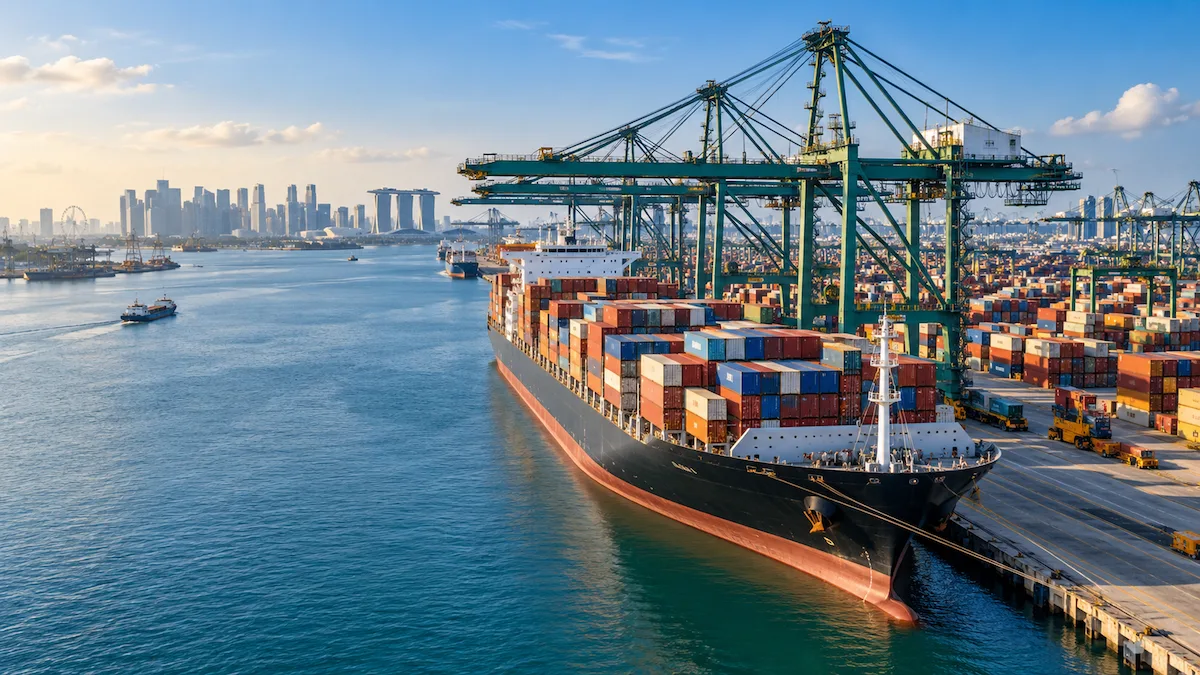
Review date: 12 October 2026. The data and regulations below are sourced to the referenced official pages, but operational details should be rechecked before a live booking or later content update. DDP Atlas has not supplied a verified Singapore route rate card or confirmed live carrier timetable for this package; accordingly, the article makes no specific live-rate or guaranteed-transit claim. Hypothetical examples are clearly labelled. The hero image is illustrative and AI-generated.
- Singapore Customs — Obtain a Customs Import Permit (TradeNet, UEN, declaring agent).
- Singapore Customs — Activate/Update/Terminate Customs Account (activation fee and requirements).
- Singapore Customs — Import Procedures Overview (basic legal framework and tax/duty categories).
- Singapore Customs — Goods and Services Tax (import GST calculation).
- Singapore Customs — Customs Valuation Methods (valuation framework).
- IRAS — Current GST Rates (9% standard rate).
- Singapore Customs — Duties and Dutiable Goods (four broad dutiable groups).
- Singapore Customs — Controlled and Prohibited Goods and HS/CA guidance.
- Singapore Customs — Documents for Clearance (mode-specific presentation rules).
- Singapore Customs — Depositing Goods in Free Trade Zones (GST/duty suspension mechanics).
- Maritime and Port Authority — Singapore Terminals and Tuas Port.
- Maritime and Port Authority — Singapore 2025 Port Performance.
- Changi Airport Group — Air Cargo Gateway.
- Singapore Customs — Preferential Tariff Treatment.
- ICC — Incoterms® 2020.
- IPPC — ISPM 15 for Wood Packaging.
Scope note: This is an informational buyer guide, not a freight quotation, a promise of cargo acceptance, customs/legal/tax advice, a current sailing schedule, or a substitute for official Singapore Customs/IRAS requirements. Seek qualified confirmation for the specific import, and refresh time-sensitive operational details before publication and periodically afterwards.
What importers ask before booking.
What is the cheapest way to ship from China to Singapore?
There is no universally cheapest mode. For larger, non-urgent volumes, start by comparing ocean FCL and LCL on complete delivered cost. For small shipments, express or air can be competitive once ocean minimum charges, CFS fees and door delivery are considered. Use the same cargo dimensions and named delivery point for each quote.
How much is sea freight from China to Singapore in 2026?
A reliable price depends on the China origin, equipment or chargeable W/M, departure date, carrier, destination handling, pickup, documentation and delivery scope. This guide does not assert a live October 2026 rate. Ask for a written, dated quote and a breakdown of what is included and excluded.
How long does sea freight from China to Singapore take?
The actual timeline changes by origin port, booked carrier service, transshipment, cutoffs, arrival handling, Customs release and destination trucking. Request both the dated port-to-port itinerary and the estimated full cargo-ready-to-door timeline rather than one unqualified day count.
Is there air freight from Shenzhen, Guangzhou or Shanghai to Singapore?
These are logical China origin regions to evaluate, but current uplift, direct-flight availability, airline acceptance and price must be confirmed for the requested dates and commodity. The supplier's city alone does not establish the best export airport.
What is the GST rate when importing goods into Singapore?
The prevailing GST rate is 9%. The taxable import base and possible exceptions are set by the Singapore Customs and IRAS rules, not simply the invoice amount or a freight forwarder's headline rate. Review classification, valuation, special schemes and importer's records.
Does Singapore charge customs duty on all goods from China?
No. Singapore identifies four broad categories of dutiable goods, while many other imports are non-dutiable but subject to GST. Check the correct Singapore HS classification and product-specific rules rather than assuming a universal import-duty percentage.
Do I need a Singapore import permit or TradeNet account?
For typical commercial imports, a Customs import permit is handled through TradeNet. The Singapore importing entity normally needs a UEN and activated Customs Account, and can use an appointed declaring agent. Certain goods and shipment types have specific exemptions or alternative procedures; the responsible importer should confirm them.
Is DDP shipping from China to Singapore possible?
A DDP-type shipment may be commercially discussed, but the parties must ensure the seller can fulfill the applicable Singapore import formalities, tax obligations and contractual scope through a lawful operational setup. DDP should not be promised merely because a forwarder says “tax included.” Where the structure does not work, define another term transparently.
Should I use FCL or LCL for a small wholesale order?
Begin with LCL if the order is clearly below dedicated-container scale, then compare FCL as quantities grow. Check minimums, CFS charges, additional handling, cargo sensitivity and receiving requirements. No single CBM cutoff works for every lane or rate period.
Can I consolidate cartons from several Chinese factories?
Often yes, if the forwarder and receiving warehouse accept the goods and the paperwork is coordinated. Provide a supplier-level packing list, cargo-ready dates, invoice details and identification marks. Confirm whether consolidation, storage, remeasurement, sorting and extra pickup charges are included.
Do I need a certificate of origin for all goods?
Not necessarily. Origin evidence may be required for a specific preferential tariff claim, trade control, contract or compliance review. A certificate of origin does not itself waive Singapore's import GST. Validate the requirement for the actual HS code and transaction.
Can DDP Atlas provide an instant fixed online rate?
Only where the booking/estimate system has a valid, approved and complete rate matched to the actual cargo and service scope should it display an explicitly labelled estimate. Otherwise, use Quote Review and confirm final terms before booking. The calculator and guide are not offers of guaranteed price or capacity.
Need a service plan for this destination?
Send the pickup city, destination, cargo and timing. The freight team can review the appropriate mode and scope.