
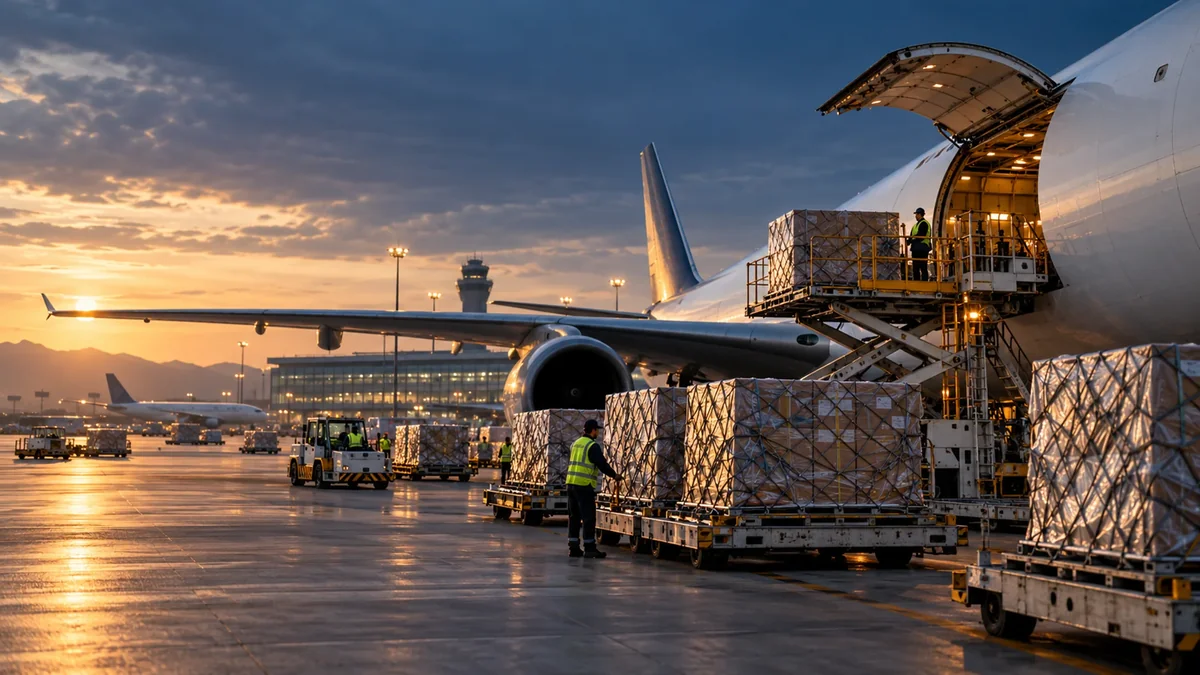
Apparel is often well suited to airfreight when seasonal sell-through or replenishment urgency supports the premium cost. Its weight and volume profile means carton construction and product density can materially affect billable kilograms.
Illustrative planning case, not a booked DDP Atlas shipment. A brand launches a capsule collection with incomplete sizes. Airshipping only the missing key sizes may protect its launch without paying airfreight for the full production run.
Acceptance data for apparel air freight
| Priority | Evidence or input |
|---|---|
| 1 | Approved size/color SKU matrix |
| 2 | Packed carton dimensions |
| 3 | Garment hang/flat packaging |
| 4 | Merchandising cutoff |
| 5 | Split-shipment quantity |
| 6 | Delivery distribution center |
How to plan apparel by air
The first step for air freight apparel from China is cargo disclosure. A booking request should state the exact product, composition or technical characteristics relevant to air transport, piece dimensions and weight, packaging and destination. If the cargo includes batteries, liquids, powders, chemicals, aerosols, magnets or other regulated characteristics, flag them before a standard rate is assumed.
Launch allocation
Calculate the exact quantity that needs air speed and move the stable balance by a lower-cost mode.
The first step for air freight apparel from China is cargo disclosure. A booking request should state the exact product, composition or technical characteristics relevant to air transport, piece dimensions and weight, packaging and destination. If the cargo includes batteries, liquids, powders, chemicals, aerosols, magnets or other regulated characteristics, flag them before a standard rate is assumed.
Airline acceptance and destination import permission are separate questions. A product can be physically acceptable to an airline yet still require destination permits or consignee arrangements. Conversely, a commercially legal product can still need special aviation classification, packing or documentation.
Illustrative planning case, not a booked DDP Atlas shipment. A brand launches a capsule collection with incomplete sizes. Airshipping only the missing key sizes may protect its launch without paying airfreight for the full production run.
Key takeaways
- Apparel air freight is often driven by launch dates, replenishment shortages, samples or a controlled portion of a larger order.
- Carton dimensions can make lightweight garments highly volumetric, so packing density is an important cost lever.
- Split shipment planning can protect a launch while the balance moves by a lower-cost mode.
- Describe the product and any battery, liquid, powder, magnet, chemical or temperature-sensitive characteristic before quoting.
- Confirm piece weight and dimensions for heavy or oversized cargo.
The decision in one table
| Decision point | What to check |
|---|---|
| Classification | Describe the cargo accurately and identify regulated or restricted characteristics. |
| Packaging | Confirm packaging protects the product and meets any applicable transport requirements. |
| Acceptance | Check current airline/handler rules before moving cargo to the airport. |
| Destination | Verify import and consignee requirements separately from airline acceptance. |
Information to send for apparel air freight
- Exact product name and commercial use.
- SDS/specification or battery data where relevant.
- Number of pieces, weight and dimensions.
- Packaging configuration and photos if the cargo is unusual.
- Destination country and consignee/importer setup.
- Any temperature, security, non-stackable or handling requirement.
Planning example: apparel air freight
A fashion brand is short 2,000 units before launch. It flies only the quantity needed for launch-week sales, optimizes carton density, and sends the replenishment balance by sea. Air freight protects revenue without becoming the default for the whole order.
Frequently asked questions
When should special cargo be declared?
Before quoting and routing. Product characteristics can change acceptance, documents, packaging, handling and available carriers.
Can a forwarder decide whether dangerous goods are allowed from a product name alone?
No. Classification and acceptance may require technical details, safety data, battery specifications or other documentation under current rules.
Does air freight automatically protect fragile cargo?
No. Air freight is faster, but cargo still passes through warehouses, forklifts, screening and transfers. Packaging must be designed for those handling events.
Before you book air freight apparel from China: Confirm acceptance requirements for this specific cargo before the rate is fixed, because handling rules can change what can be uplifted. The shared operating sequence and pre-booking checklist live on the Air Freight from China hub.
Where apparel air freight goes wrong
Where importers lose time or money. Risk 1: Cargo is misdeclared as general cargo. Risk 2: Packaging is not compatible with the product or air-transport requirement. Risk 3: A destination import restriction is discovered after uplift. Risk 4: High-value, temperature-sensitive or oversized handling is not included in the standard quote.
Buyer control matrix.
Quoting before the cartons are measured. Apparel is a volumetric commodity. Billed weight follows the packed carton dimensions, so a quote built on the flat-packed estimate rather than the measured carton is provisional.
Compressing cartons until the goods mark. Reducing volume lowers the volumetric weight and therefore the charge. It also creases and distorts product, and the saving on one shipment is easily lost on the first customer claim.
Shipping the whole launch by air out of habit. A split — the first display quantities by air and the balance by sea — is frequently cheaper than sending everything by air, and reaches the shelf at almost the same time.
Forgetting the volumetric divisor. Two forwarders can apply the same tariff differently if one measures loose cartons and the other measures the palletised unit. Confirm which measurement basis the quote uses.
Assuming the air shipment and the sea shipment will match. Colour and size ratios between an air shipment and a later sea shipment often differ, which causes real problems at retail if it is not planned.
Related guides
Air Freight Apparel and Fashion from China: Launches Replenishment and Carton Planning continues the Air Freight from China hub.
- Air Freight Cargo Types from China: General Special & Restricted Cargo
- Air Freight Electronics from China: Packing Batteries Security and Routing
- Air Freight Machinery and Spare Parts from China: Urgent Industrial Cargo Guide
- Shipping Lithium Batteries from China by Air and Sea
Guides that continue from Air Freight Apparel and Fashion from China: Launches Replenishment and C:
- Air Freight Cargo Types from China: General Special & Restricted Cargo
- Air Freight Electronics from China: Packing Batteries Security and Routing
- Air Freight Machinery and Spare Parts from China: Urgent Industrial Cargo Guide
- Shipping Lithium Batteries from China by Air and Sea
- Air Freight from China hub
- Standard air-freight operating checklist
Why apparel pays for volume, not for weight
Air freight is priced on the greater of actual weight and volumetric weight. For most apparel, volumetric weight wins by a wide margin — a carton of garments weighs very little relative to the space it occupies. Three consequences follow.
- The measured carton is the price driver. Garment weight is not the number to optimise; the packed carton dimensions are.
- Packing method is a cost decision. Flat-packing, garment-bagging and vacuum reduction change the cubic volume, and therefore the billed weight, of exactly the same goods.
- Palletising changes the measurement basis. A consignment measured as loose cartons and the same consignment measured as a palletised unit can yield different volumetric weights. Confirm which basis the quotation uses.
The planning question is rarely “air or sea”. It is usually “how much by air, and by when”. Launch quantities, replenishment quantities and end-of-season make-weight quantities have different deadlines and different economics, and treating them as one shipment is usually what makes air freight look expensive.
Operational verification: airline acceptance, dangerous-goods rules, battery requirements, customs procedures, schedules, capacity and charges can change. Confirm current requirements for the actual cargo, carrier, route and booking date.
Related air-freight guidance.
Use these links to move up the cluster or compare the most relevant sibling decision.