
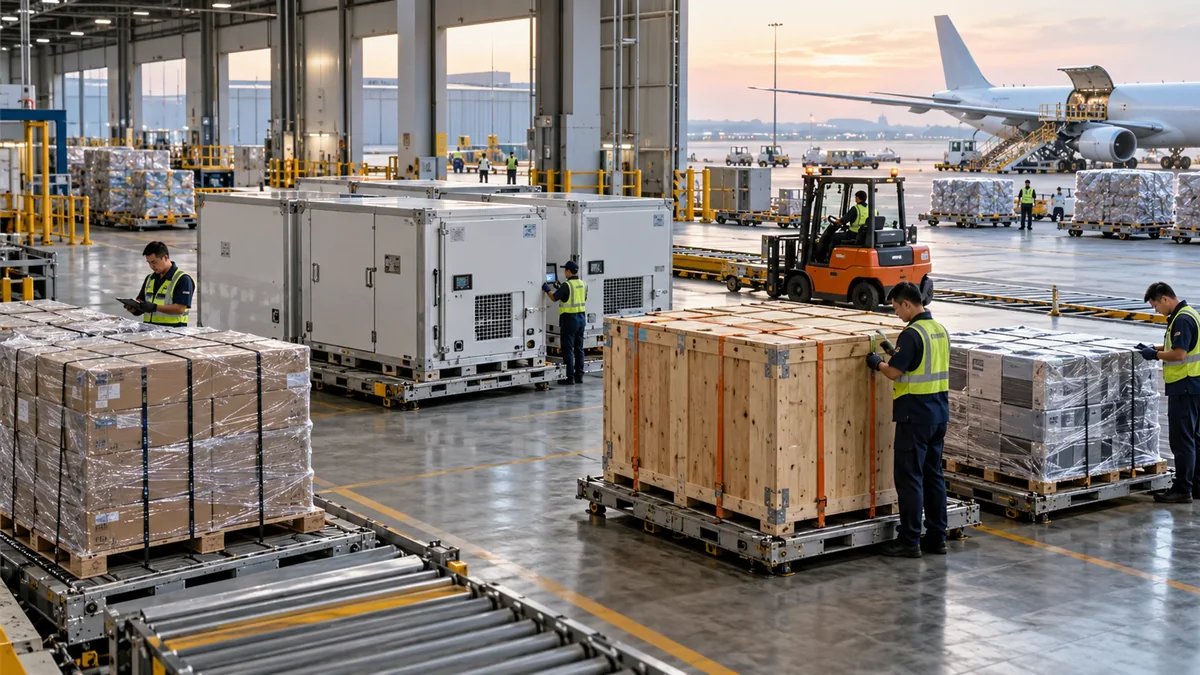
Cargo characteristics can change whether a shipment is accepted, how it must be packed, which documents are required and which routings are available. Special cargo should be declared before a standard air-freight route or rate is assumed.
This hub organizes the practical decisions around air freight cargo types from China. It is not a thin category archive: use it to move from a broad air-freight question into the specific guide that matches the shipment problem.
What importers should decide first
- Describe the product and any battery, liquid, powder, magnet, chemical or temperature-sensitive characteristic before quoting.
- Confirm piece weight and dimensions for heavy or oversized cargo.
- Use current regulatory and carrier requirements for dangerous goods and batteries.
- Do not rely on a generic commodity description when cargo acceptance depends on technical details.
How to use this hub in a real shipment
Start with the cargo and deadline, then move to the guide that resolves the main uncertainty. If the shipment is still at RFQ stage, prioritize data quality and scope. If cargo is already ready, prioritize acceptance, cut-off and route execution. If the shipment has already departed, move to destination documentation, customs and exception control.
Decision framework
| Decision point | What to check |
|---|---|
| Classification | Describe the cargo accurately and identify regulated or restricted characteristics. |
| Packaging | Confirm packaging protects the product and meets any applicable transport requirements. |
| Acceptance | Check current airline/handler rules before moving cargo to the airport. |
| Destination | Verify import and consignee requirements separately from airline acceptance. |
Cargo acceptance matrix
Special-cargo planning begins by declaring what the product actually is. “Electronics,” “cosmetics” or “machine parts” can hide characteristics that materially change airline acceptance.
| Cargo characteristic | Questions before quoting |
|---|---|
| Batteries | Chemistry, configuration, Wh/lithium content as applicable, test/document status, packing |
| Liquid/aerosol/chemical | Composition, SDS where relevant, flash point/classification if applicable, package size |
| Magnetized equipment | Product construction and any required testing/handling review |
| Temperature-sensitive | Required range, excursion tolerance, packaging and monitoring plan |
| High value | Security, insurance, handoff control and delivery authorization |
| Heavy/oversized | Piece dimensions/weight, lifting method, aircraft/loadability and ground handling |
The forwarder should review transport acceptance and destination import compliance separately. Passing one does not prove the other.
Cargo-specific service design
For sensitive cargo, route selection is part of risk control. Fewer transfers can reduce handling, but a more frequent connecting service can offer better recovery. High-value freight may justify stronger warehouse/security controls. Perishables require maximum dwell-time thinking. Oversized cargo requires piece-level loadability. The cargo type should change the questions asked before booking.
Special-cargo intake workflow
A scalable forwarder should use a structured intake rather than relying on sales staff to recognize every restricted product from a description. The intake can ask whether the cargo contains batteries, liquids, aerosols, chemicals, powders, magnets, temperature requirements, high-value items, live/perishable material or oversized pieces.
A positive answer triggers the relevant technical review. The commercial team should not promise acceptance until that review is complete. This workflow reduces the risk of cargo reaching the warehouse under a route that cannot legally or operationally accept it.
For regulated topics, the public website should direct users to provide data; the operational team should use licensed/current regulatory materials for the actual classification and packing decision.
Use a cargo-intake decision tree
The first question is whether the shipment can be treated as ordinary general cargo. If the product contains batteries, dangerous substances, liquids, aerosols, powders, magnets, temperature requirements, high-value theft exposure or unusual dimensions, route it into a specialized review before pricing is finalized.
The second question is whether the destination imposes an import control separate from air-transport acceptance. Cosmetics, food/perishables, medical-related goods, chemicals and regulated electronics can require market-specific documentation or importer capability even when the airline can carry them.
The third question is whether the packaging supports the planned handling. Heavy, oversized and temperature-sensitive cargo can fail operationally because the package is not suitable, even when the product itself is acceptable.
Data-quality rule
A public product name is not enough. Ask for the model/SKU, technical composition where relevant, battery configuration, SDS/test/certificate information as applicable, piece-level dimensions, gross weight and final packing. This is especially important when supplier sales staff use broad descriptions such as “accessories,” “beauty products” or “machine parts.”
The role of this hub is to direct readers into the correct specialized article while making clear that final acceptance is shipment-specific.
Common failure modes
- Cargo is misdeclared as general cargo.
- Packaging is not compatible with the product or air-transport requirement.
- A destination import restriction is discovered after uplift.
- High-value, temperature-sensitive or oversized handling is not included in the standard quote.
Information to prepare
- Exact product name and commercial use.
- SDS/specification or battery data where relevant.
- Number of pieces, weight and dimensions.
- Packaging configuration and photos if the cargo is unusual.
- Destination country and consignee/importer setup.
- Any temperature, security, non-stackable or handling requirement.
Frequently asked questions
When should special cargo be declared?
Before quoting and routing. Product characteristics can change acceptance, documents, packaging, handling and available carriers.
Can a forwarder decide whether dangerous goods are allowed from a product name alone?
No. Classification and acceptance may require technical details, safety data, battery specifications or other documentation under current rules.
Does air freight automatically protect fragile cargo?
No. Air freight is faster, but cargo still passes through warehouses, forklifts, screening and transfers. Packaging must be designed for those handling events.
Next step
Use the relevant child guide to resolve the shipment-specific decision, or request a freight estimate with final carton count, weight, dimensions, commodity, pickup location, destination and required delivery date.
Before you book air freight cargo types from China: Confirm the decision you are actually making — mode, timing or scope — before the quote is requested, not after it arrives. The shared operating sequence and pre-booking checklist live on the Air Freight from China hub.
Related guides
Air Freight Cargo Types from China: General Special & Restricted Cargo continues the Air Freight from China hub.
- Shipping Lithium Batteries from China by Air and Sea
- Air Freight Dangerous Goods from China: Classification Documents and Booking
- Air Freight Electronics from China: Packing Batteries Security and Routing
- Air Freight Apparel and Fashion from China: Launches Replenishment and Carton Planning
Guides that continue from Air Freight Cargo Types from China: General Special & Restricted Cargo:
- Shipping Lithium Batteries from China by Air and Sea
- Air Freight Dangerous Goods from China: Classification Documents and Booking
- Air Freight Electronics from China: Packing Batteries Security and Routing
- Air Freight Apparel and Fashion from China: Launches Replenishment and Carton Planning
- Air Freight from China hub
- Standard air-freight operating checklist
Operating process shared by the Air Freight Cargo Types from China guides
Current-rule verification
Where dangerous-goods or battery provisions apply, verify the edition in force at booking time. In 2026, IATA's updated cargo manuals include significant battery-related revisions, and ICAO's 2025–2026 Technical Instructions remain the governing biennial technical edition through 31 December 2026. Operator variations can be more restrictive than the baseline rules.
Operational verification: airline acceptance, dangerous-goods rules, battery requirements, customs procedures, schedules, capacity and charges can change. Confirm current requirements for the actual cargo, carrier, route and booking date.