
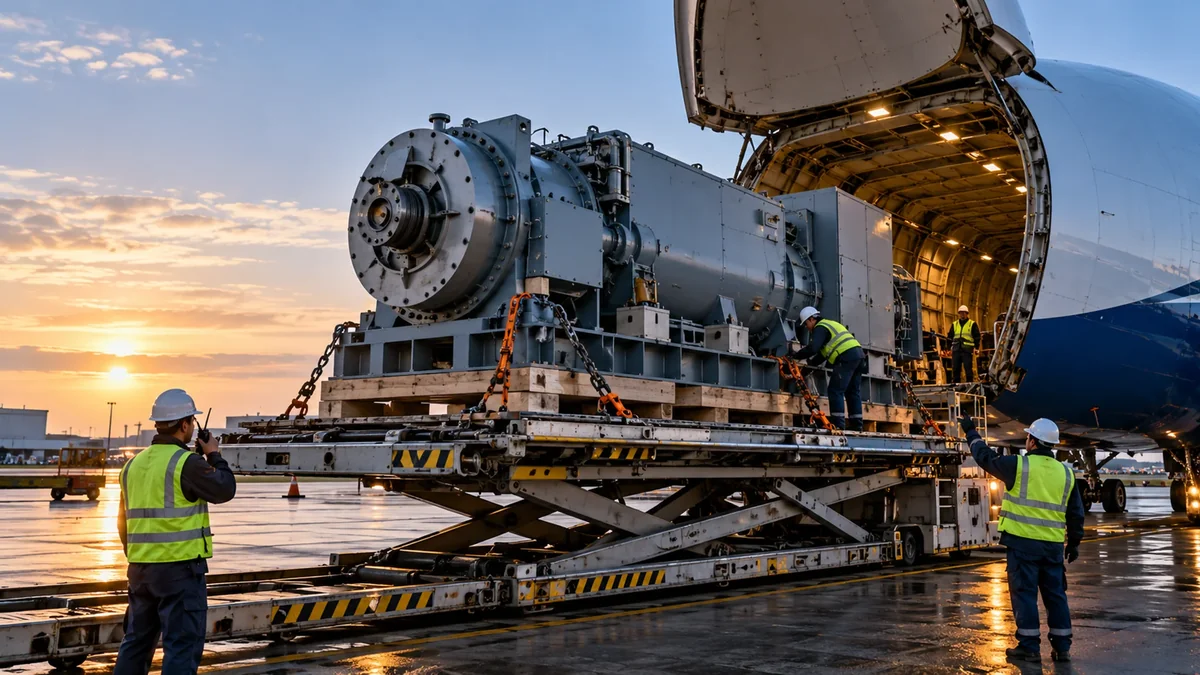
Oversized or unusually heavy air cargo requires aircraft and ground-handling feasibility before any commercial price is credible. A shipment can fit a building's loading dock yet exceed an aircraft door, floor-load or handling-equipment constraint.
Illustrative planning case, not a booked DDP Atlas shipment. A machine skid is quoted by net weight alone, then arrives at the terminal with additional framing that exceeds the planned loadable envelope. A dimension check before booking prevents a costly failed tender.
Acceptance data for oversized and heavy air cargo
| Priority | Evidence or input |
|---|---|
| 1 | Largest individual-piece dimensions |
| 2 | Packed gross weight |
| 3 | Center of gravity |
| 4 | Rigging/forklift access |
| 5 | Aircraft/airport acceptance |
| 6 | Destination offload capability |
How to plan oversized air cargo
The first step for oversized air freight from China is cargo disclosure. A booking request should state the exact product, composition or technical characteristics relevant to air transport, piece dimensions and weight, packaging and destination. If the cargo includes batteries, liquids, powders, chemicals, aerosols, magnets or other regulated characteristics, flag them before a standard rate is assumed.
Loadability engineering
Check aircraft/terminal piece limits before pickup for long, tall or heavy cargo.
The first step for oversized air freight from China is cargo disclosure. A booking request should state the exact product, composition or technical characteristics relevant to air transport, piece dimensions and weight, packaging and destination. If the cargo includes batteries, liquids, powders, chemicals, aerosols, magnets or other regulated characteristics, flag them before a standard rate is assumed.
Airline acceptance and destination import permission are separate questions. A product can be physically acceptable to an airline yet still require destination permits or consignee arrangements. Conversely, a commercially legal product can still need special aviation classification, packing or documentation.
Illustrative planning case, not a booked DDP Atlas shipment. A machine skid is quoted by net weight alone, then arrives at the terminal with additional framing that exceeds the planned loadable envelope. A dimension check before booking prevents a costly failed tender.
Key takeaways
- Air cargo is constrained by aircraft door dimensions, compartment geometry, floor loading and handling equipment as well as weight.
- Piece-level dimensions and weight are essential; total shipment CBM is not enough to determine loadability.
- Oversized cargo may require a different gateway, freighter aircraft or special handling and should be reviewed before trucking to the airport.
- Describe the product and any battery, liquid, powder, magnet, chemical or temperature-sensitive characteristic before quoting.
- Confirm piece weight and dimensions for heavy or oversized cargo.
The decision in one table
| Decision point | What to check |
|---|---|
| Classification | Describe the cargo accurately and identify regulated or restricted characteristics. |
| Packaging | Confirm packaging protects the product and meets any applicable transport requirements. |
| Acceptance | Check current airline/handler rules before moving cargo to the airport. |
| Destination | Verify import and consignee requirements separately from airline acceptance. |
Information to send for oversized and heavy air cargo
- Exact product name and commercial use.
- SDS/specification or battery data where relevant.
- Number of pieces, weight and dimensions.
- Packaging configuration and photos if the cargo is unusual.
- Destination country and consignee/importer setup.
- Any temperature, security, non-stackable or handling requirement.
Planning example: oversized and heavy air cargo
A long industrial component is relatively light but may not fit through the planned aircraft door. The forwarder checks piece-level dimensions and available aircraft before accepting the booking, avoiding an expensive rejected terminal delivery.
Frequently asked questions
When should special cargo be declared?
Before quoting and routing. Product characteristics can change acceptance, documents, packaging, handling and available carriers.
Can a forwarder decide whether dangerous goods are allowed from a product name alone?
No. Classification and acceptance may require technical details, safety data, battery specifications or other documentation under current rules.
Does air freight automatically protect fragile cargo?
No. Air freight is faster, but cargo still passes through warehouses, forklifts, screening and transfers. Packaging must be designed for those handling events.
Before you book oversized air freight from China: Confirm acceptance requirements for this specific cargo before the rate is fixed, because handling rules can change what can be uplifted. The shared operating sequence and pre-booking checklist live on the Air Freight from China hub.
Where oversized and heavy air cargo goes wrong
Where importers lose time or money. Risk 1: Cargo is misdeclared as general cargo. Risk 2: Packaging is not compatible with the product or air-transport requirement. Risk 3: A destination import restriction is discovered after uplift. Risk 4: High-value, temperature-sensitive or oversized handling is not included in the standard quote.
Buyer control matrix.
Sizing the piece against the aircraft instead of the ground equipment. A piece can be within an aircraft’s limits and still not be loadable with the handling equipment available at that station.
Leaving the load plan until the cargo is at the terminal. Where a load plan or tie-down approval is required, it has to be produced and approved before the piece arrives, and it depends on final dimensions and weight distribution.
Incomplete centre-of-gravity information. Handling and restraint planning needs the weight and the position of that weight within the piece, not just a total.
Ignoring the destination road. The last few kilometres decide feasibility more often than the flight does. Low bridges, narrow access, restricted delivery hours and the absence of a crane at the receiving site are all consignee-side facts that must be checked before the booking is confirmed.
Assuming a second handling charge is optional. Oversize and heavy pieces often need special equipment at both ends, and each end prices it separately.
Related guides
Oversized and Heavy Air Cargo from China: Aircraft Limits Packing and Handling continues the Air Freight from China hub.
- Air Freight Cargo Types from China: General Special & Restricted Cargo
- Perishable and Temperature-Sensitive Air Cargo from China
- Shipping Lithium Batteries from China by Air and Sea
Guides that continue from Oversized and Heavy Air Cargo from China: Aircraft Limits Packing and Ha:
- Air Freight Cargo Types from China: General Special & Restricted Cargo
- Perishable and Temperature-Sensitive Air Cargo from China
- Shipping Lithium Batteries from China by Air and Sea
- Air Freight from China hub
- Standard air-freight operating checklist
The three gates an outsized piece has to pass
Outsized and heavy cargo is rejected for one of three reasons, and all three have to be cleared before the booking is worth confirming.
| Gate | The question | Who answers it |
|---|---|---|
| Aircraft | Do the piece dimensions, weight and loadability fit the type operating the route, and is a load plan needed? | Airline / ground handling |
| Origin station | Can the piece be lifted, moved and loaded with the equipment available at that airport and terminal? | Origin handler |
| Destination | Can the piece be unloaded, and can it physically reach the final address? | Destination handler and consignee |
Passing the first gate says nothing about the other two. A piece can be perfectly compatible with the aircraft and still be unloadable at the arrival station, or loadable but unable to pass a low bridge on the final approach to the consignee.
The information that has to be collected before any of this can be assessed is small and specific: dimensions and weight per piece, the position of the weight within the piece, the lifting points, the proposed packaging, and the delivery address. Getting those five items right at the start avoids a re-quote at the terminal, which is the most expensive place to discover an error.
Operational verification: airline acceptance, dangerous-goods rules, battery requirements, customs procedures, schedules, capacity and charges can change. Confirm current requirements for the actual cargo, carrier, route and booking date.
Related air-freight guidance.
Use these links to move up the cluster or compare the most relevant sibling decision.