
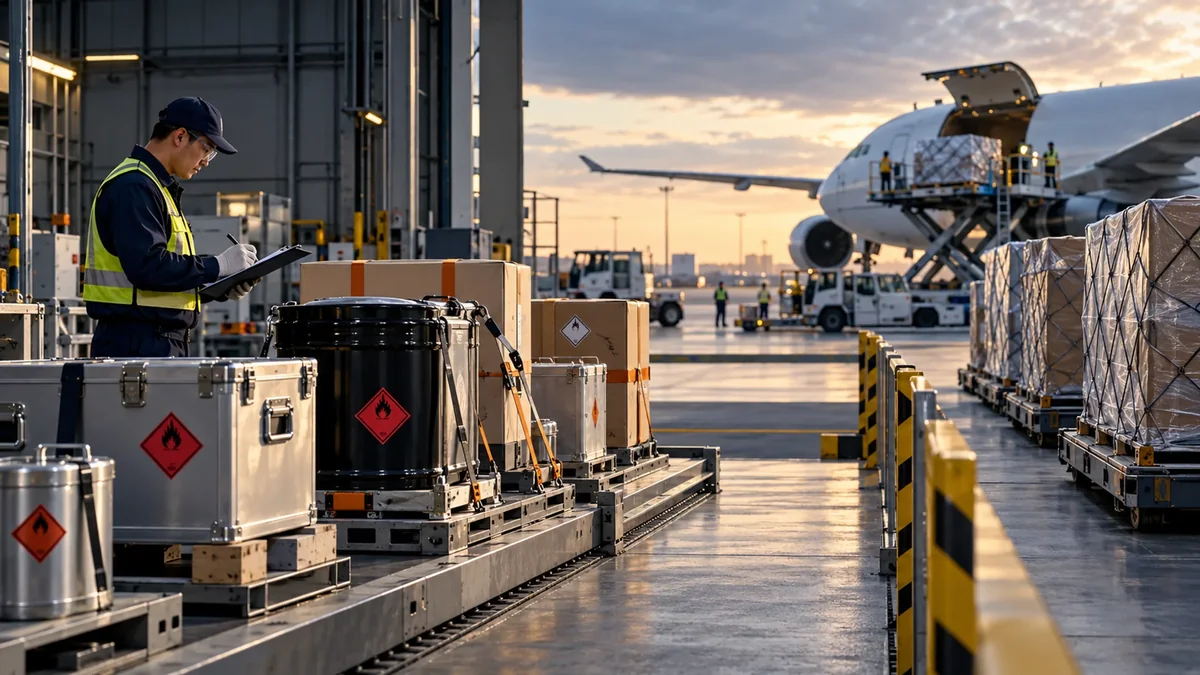
Dangerous-goods airfreight starts with classification, not booking. The shipper must determine whether the exact product and packaging fall within the applicable dangerous-goods provisions, then prepare the required marks, labels, documents and certified packaging where required.
Illustrative planning case, not a booked DDP Atlas shipment. A supplier sends a product marketed as “nonhazardous industrial liquid” without composition data. The freight team must obtain the proper technical information before deciding whether the airline can accept it. Commercial product descriptions are not transport classifications.
Acceptance data for dangerous-goods air freight
| Priority | Evidence or input |
|---|---|
| 1 | Technical product classification |
| 2 | UN number if applicable |
| 3 | Packing instruction and package group |
| 4 | Trained-shipper documentation |
| 5 | Carrier/operator variations |
| 6 | Destination legality |
Illustrative planning case, not a booked DDP Atlas shipment. A supplier sends a product marketed as “nonhazardous industrial liquid” without composition data. The freight team must obtain the proper technical information before deciding whether the airline can accept it. Commercial product descriptions are not transport classifications.
Key takeaways
- Dangerous goods must be correctly classified, packed, marked, labelled and documented under the applicable current rules and carrier variations.
- The IATA DGR is updated annually; booking instructions should therefore be verified against the edition in force and the airline/operator variations.
- Undeclared or misdeclared dangerous goods create safety and delay risks and may be refused.
- Describe the product and any battery, liquid, powder, magnet, chemical or temperature-sensitive characteristic before quoting.
- Confirm piece weight and dimensions for heavy or oversized cargo.
The decision in one table
| Decision point | What to check |
|---|---|
| Classification | Describe the cargo accurately and identify regulated or restricted characteristics. |
| Packaging | Confirm packaging protects the product and meets any applicable transport requirements. |
| Acceptance | Check current airline/handler rules before moving cargo to the airport. |
| Destination | Verify import and consignee requirements separately from airline acceptance. |
How to plan dangerous goods acceptance
The first step for air freight dangerous goods from China is cargo disclosure. A booking request should state the exact product, composition or technical characteristics relevant to air transport, piece dimensions and weight, packaging and destination. If the cargo includes batteries, liquids, powders, chemicals, aerosols, magnets or other regulated characteristics, flag them before a standard rate is assumed.
Airline acceptance and destination import permission are separate questions. A product can be physically acceptable to an airline yet still require destination permits or consignee arrangements. Conversely, a commercially legal product can still need special aviation classification, packing or documentation.
Information to send for dangerous-goods air freight
- Exact product name and commercial use.
- SDS/specification or battery data where relevant.
- Number of pieces, weight and dimensions.
- Packaging configuration and photos if the cargo is unusual.
- Destination country and consignee/importer setup.
- Any temperature, security, non-stackable or handling requirement.
Planning example: dangerous-goods air freight
A supplier says a chemical product is “safe” but cannot provide classification information. The forwarder pauses the standard booking and requests the technical data needed to determine whether dangerous-goods rules apply. Convenience is not a classification method.
Frequently asked questions
When should special cargo be declared?
Before quoting and routing. Product characteristics can change acceptance, documents, packaging, handling and available carriers.
Can a forwarder decide whether dangerous goods are allowed from a product name alone?
No. Classification and acceptance may require technical details, safety data, battery specifications or other documentation under current rules.
Does air freight automatically protect fragile cargo?
No. Air freight is faster, but cargo still passes through warehouses, forklifts, screening and transfers. Packaging must be designed for those handling events.
Where dangerous-goods air freight goes wrong
Where importers lose time or money. Risk 1: Cargo is misdeclared as general cargo. Risk 2: Packaging is not compatible with the product or air-transport requirement. Risk 3: A destination import restriction is discovered after uplift. Risk 4: High-value, temperature-sensitive or oversized handling is not included in the standard quote.
Classification before quotation
Technical classification determines what packing, documentation and operator acceptance apply.
Buyer control matrix.
Booking against an unclassified product. The most common failure is a rate being sought before the product has been classified. Accepting a rate first creates a commercial expectation that the classification may not support.
Assuming “not dangerous” from a marketing description. Commercial product names are not transport classifications. A product described as industrial, cosmetic or food-grade can still be regulated because of its composition, alcohol content, flash point, pH or physical form.
Using an out-of-date rule set. The dangerous-goods regulations are re-issued annually and airlines publish their own variations on top. An instruction set from a previous edition is not a basis for acceptance.
Packaging that does not match the packing instruction. The required packaging is specified by classification, not chosen by the shipper. Substituting a cheaper box invalidates the acceptance.
Documentation signed by an untrained person. The shipper’s declaration carries legal weight and must be completed by someone competent to make it.
Treating acceptance and import permission as one question. An airline accepting a shipment says nothing about whether the destination country permits it. Both controls have to be satisfied separately.
Related guides
Air Freight Dangerous Goods from China: Classification Documents and Booking continues the Air Freight from China hub.
- Air Freight Cargo Types from China: General Special & Restricted Cargo
- Shipping Lithium Batteries from China by Air and Sea
- Air Freight Electronics from China: Packing Batteries Security and Routing
- Oversized and Heavy Air Cargo from China: Aircraft Limits Packing and Handling
Guides that continue from Air Freight Dangerous Goods from China: Classification Documents and Boo:
- Air Freight Cargo Types from China: General Special & Restricted Cargo
- Shipping Lithium Batteries from China by Air and Sea
- Air Freight Electronics from China: Packing Batteries Security and Routing
- Oversized and Heavy Air Cargo from China: Aircraft Limits Packing and Handling
- Air Freight from China hub
- Standard air-freight operating checklist
What classification actually decides
Before a dangerous-goods shipment can be booked, five pieces of information have to be established. They are the output of classification, and each one constrains what can be carried and how.
| Element | What it fixes |
|---|---|
| Proper shipping name | The name the shipment must travel under — not the marketing or trade name |
| UN number | The identifier that ties the entry to its handling requirements |
| Hazard class (and subsidiary risk) | The hazard category that governs stowage and segregation |
| Packing group | The level of danger within the class, where the entry uses packing groups |
| Packing instruction | The packaging specification that must be used, per class and quantity |
Those five elements then determine the marks and labels, the shipper’s declaration, the packaging, and which operators will accept the shipment. Because the regulations are re-issued annually and airlines add their own variations, the classification must be worked against the edition and the operator variations in force — not against a previous shipment’s paperwork.
A practical consequence for buyers: questions about a dangerous-goods shipment are answered faster when the technical data arrives with the request. A shipping name, a composition or a safety data sheet lets a forwarder tell you what is possible. A product brochure does not.
Operational verification: airline acceptance, dangerous-goods rules, battery requirements, customs procedures, schedules, capacity and charges can change. Confirm current requirements for the actual cargo, carrier, route and booking date.
Related air-freight guidance.
Use these links to move up the cluster or compare the most relevant sibling decision.