
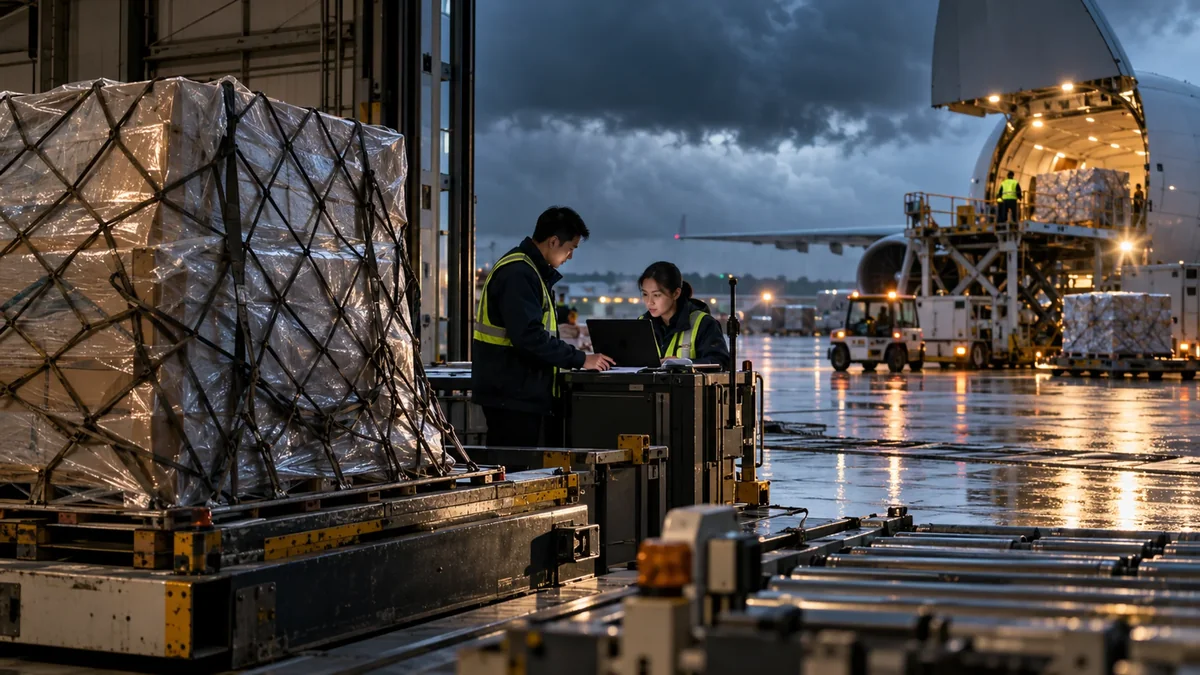
An airfreight delay can occur before uplift, in transit or after arrival. The correct response depends on which milestone failed; repeated generic status updates are less useful than identifying the affected cargo and actionable recovery choice.
Illustrative planning case, not a booked DDP Atlas shipment. A consignee receives a status saying “delayed in transit.” The shipment might still be at origin pending document correction. A milestone-based investigation prevents the team from solving the wrong problem.
Trigger data for delay control
| Priority | Evidence or input |
|---|---|
| 1 | Last confirmed physical event |
| 2 | Reason code and evidence |
| 3 | Revised uplift option |
| 4 | Customs release state |
| 5 | Owner and escalation time |
| 6 | Customer commitment impact |
How to plan delay prevention
For air freight delays from China, exception control begins before departure. Mark the milestones that can fail—cargo readiness, warehouse receiving, acceptance, cut-off, uplift, connection, customs and delivery—and define the recovery owner for each one.
Root-cause visibility
Separate supplier, warehouse, airline, customs and delivery delays so the next shipment can be improved.
For air freight delays from China, exception control begins before departure. Mark the milestones that can fail—cargo readiness, warehouse receiving, acceptance, cut-off, uplift, connection, customs and delivery—and define the recovery owner for each one.
Critical cargo should have a decision threshold. For example, if the planned uplift is lost, should the forwarder protect the next flight, switch gateways, split the shipment or request a premium alternative? Deciding this only after a disruption wastes the small amount of time that air freight was purchased to save.
Illustrative planning case, not a booked DDP Atlas shipment. A consignee receives a status saying “delayed in transit.” The shipment might still be at origin pending document correction. A milestone-based investigation prevents the team from solving the wrong problem.
Key takeaways
- Common air-freight delays begin with cargo not ready, changed dimensions, late documents, missed cut-offs, special-cargo issues, capacity changes, customs questions or destination delivery failures.
- A useful prevention plan assigns an owner and deadline to each milestone rather than treating “in transit” as one status.
- Recovery speed depends on how early the exception is visible and whether alternate routing or delivery options have already been evaluated.
- Build a contingency path before a deadline becomes critical.
- Track cargo-ready, acceptance and uplift milestones separately.
The decision in one table
| Decision point | What to check |
|---|---|
| Early warning | Track cargo-ready, warehouse receipt, acceptance, uplift, clearance and delivery separately. |
| Recovery | Pre-agree alternate flight/gateway or split-shipment options for critical cargo. |
| Destination control | Prepare broker, consignee and delivery details before arrival. |
| Cost exposure | Know potential storage, rehandling, rerouting and premium-recovery charges. |
Information to send for delay control
- Required delivery date and inventory consequence of delay.
- Latest safe cargo-ready date.
- Primary and alternate gateway/routing options.
- Escalation contact for supplier, forwarder, broker and consignee.
- Storage/free-time assumptions at destination.
- Decision rules for reroute, split shipment or premium recovery.
Planning example: delay control
A shipment is delayed because one supplier is late, documents change twice and the planned uplift is lost. A milestone log identifies the original failure point and prevents the entire event from being described vaguely as an “airline delay.”
Frequently asked questions
Can confirmed air cargo still be offloaded?
Operational disruption can still occur. Capacity, weight and balance, connection performance and other operational decisions may change after booking.
What is the best way to avoid airport storage?
Have broker, consignee, documents, payment authority and delivery instructions ready before arrival, and monitor the clearance/recovery milestones closely.
How should importers plan peak season?
Confirm cargo-ready data earlier, keep rate validity and capacity visible, protect cut-offs and pre-agree alternate gateways or recovery options.
Before you book air freight delays from China: Decide in advance who owns the exception and what the fallback is, rather than negotiating it after the shipment is already moving. The shared operating sequence and pre-booking checklist live on the Air Freight from China hub.
Where delay control goes wrong
Where importers lose time or money. Risk 1: Booking is treated as guaranteed uplift when operational capacity later changes. Risk 2: Delay is discovered after the last practical recovery option has passed. Risk 3: Destination storage begins while broker or consignee is unprepared. Risk 4: Peak-season pricing or route changes are approved without checking total delivery impact.
Buyer control matrix.
Separating causes from symptoms
“The shipment is delayed” is not a diagnosis. Air freight delays fall into a small number of causes, each with a different owner and a different remedy.
| Cause | Where it appears | What actually reduces it |
|---|---|---|
| Cargo not ready | Supplier misses the packing or document date | A written readiness date with a time of day, and a shipment day that is not also the packing day |
| Acceptance or screening | Cargo rejected or held at the terminal | Accurate cargo description and packaging that can be handled as presented |
| Space and priority | Booked cargo does not board | Earlier booking, a higher boarding priority where available, and a route with more than one option |
| Weather and air-traffic | Flight delayed or rerouted | Nothing, directly — but a plan with slack absorbs it |
| Documentation | Data does not match across the outputs | One master data set and a pre-departure check |
| Destination clearance or delivery | Goods arrive but do not move | Clearing party appointed in advance, and a consignee who can receive |
Two observations matter commercially. First, the causes that belong to the shipper and its suppliers — readiness, description, packaging, documents — are the majority, and they are the ones that can actually be controlled. Second, measuring where delays occur across a few shipments converts the argument from “the forwarder is slow” into a list of specific steps to change.
Related guides
Air Freight Delays from China: Causes Prevention and Recovery continues the Air Freight from China hub.
- China Air Freight Risks: Peak Season Capacity Delays & Storage
- Air Freight Peak Season from China: Capacity Rates and Booking Strategy
- Airline Offload and Rollover in Air Freight: What Importers Need to Know
- Air Cargo Storage Charges at Airports: How Importers Can Avoid Them
Guides that continue from Air Freight Delays from China: Causes Prevention and Recovery:
- China Air Freight Risks: Peak Season Capacity Delays & Storage
- Air Freight Peak Season from China: Capacity Rates and Booking Strategy
- Airline Offload and Rollover in Air Freight: What Importers Need to Know
- Air Cargo Storage Charges at Airports: How Importers Can Avoid Them
- Air Freight from China hub
- Standard air-freight operating checklist
Operational verification: airline acceptance, dangerous-goods rules, battery requirements, customs procedures, schedules, capacity and charges can change. Confirm current requirements for the actual cargo, carrier, route and booking date.
Related air-freight guidance.
Use these links to move up the cluster or compare the most relevant sibling decision.