
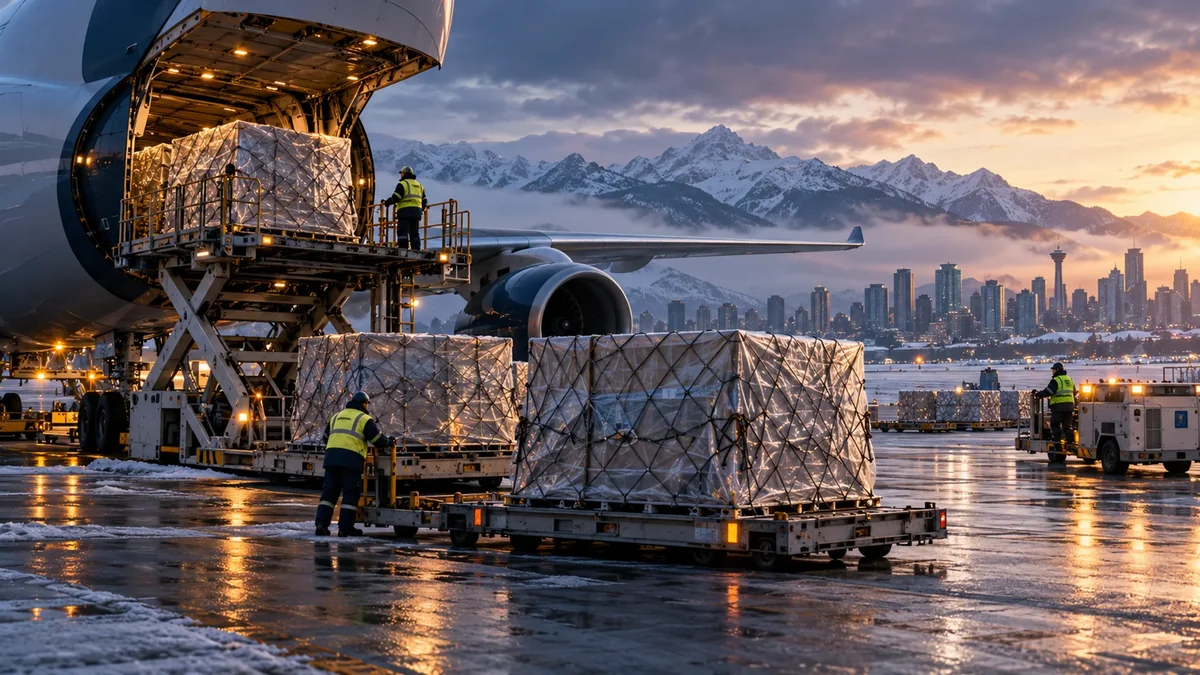
Canada-bound air cargo needs to be scoped around the Canadian importer and the final delivery province. Air arrival at a major gateway may still require substantial inland transport, and customs processes must be coordinated before arrival.
Illustrative planning case, not a booked DDP Atlas shipment. A Canadian buyer outside a major airport city chooses a low airport-arrival quote, then discovers a second freight movement is required. A delivered-cost comparison would expose the inland leg before the purchase order is approved.
Route data that shapes the China–Canada air corridor
| Priority | Evidence or input |
|---|---|
| 1 | Canadian business/importer registration |
| 2 | CBSA broker setup |
| 3 | Commodity HS classification |
| 4 | Arrival airport and province |
| 5 | Domestic truck transfer |
| 6 | Receiving appointment |
Illustrative planning case, not a booked DDP Atlas shipment. A Canadian buyer outside a major airport city chooses a low airport-arrival quote, then discovers a second freight movement is required. A delivered-cost comparison would expose the inland leg before the purchase order is approved.
Key takeaways
- China-to-Canada air freight should be planned around the complete corridor, not a generic country-level transit claim.
- Arrival options can include Vancouver, Toronto and other suitable Canadian gateways; the best gateway changes with current schedule, customs setup and final delivery.
- Key checks include importer/broker setup, airport selection versus domestic delivery, winter/seasonal risk and final receiving.
- Select the destination airport together with final-mile economics.
- Use route redundancy where inventory deadlines are critical.
The decision in one table
| Decision point | What to check |
|---|---|
| China gateway | Match origin region to the most reliable viable uplift. |
| Arrival gateway | Evaluate customs and inland delivery from the destination airport. |
| Routing | Compare direct and connecting options around deadline and handling risk. |
| Door delivery | Include customs, terminal recovery and final receiving requirements in the route plan. |
Information to send for the China–Canada air corridor
- China pickup city and preferred/available origin gateways.
- Destination city and final delivery postcode.
- Importer/broker details and customs responsibility.
- Cargo dimensions, weight and special characteristics.
- Delivery deadline and acceptable routing options.
- Receiving hours, appointments and final-mile constraints.
Planning example: the China–Canada air corridor
A Canadian shipment must reach an inland consignee. Vancouver or Toronto can produce very different domestic legs depending on origin, available uplift and final address, so the arrival airport cannot be selected by flight price alone.
Where the China–Canada air corridor goes wrong
Choosing a coast by habit. Vancouver, Toronto and Montréal serve very different inland geographies. The arrival airport should be selected from the consignee address, not from the flight options alone.
Underestimating the inland leg. Canadian distances are large, and the inland movement is a significant share of both the cost and the total lead time.
Leaving the broker out of the plan. Clearance is normally made by a licensed customs broker on behalf of the importer. That relationship should exist before the first shipment, not during it.
Omitting tax from the landed comparison. Goods and services tax and provincial tax on import are separate from duty and separate from freight, and they change the ranking of two otherwise similar quotes.
Where China–Canada air cargo actually lands
Canadian air imports from China arrive mainly through Vancouver (YVR) on the west coast, Toronto Pearson (YYZ) and Montréal-Trudeau (YUL) in the east, and Calgary (YYC) in the prairies. As with the United States, the arrival airport is a long way — often thousands of kilometres — from the final delivery address, so the inland leg is a material part of both the cost and the schedule.
Import clearance in Canada is administered by the Canada Border Services Agency, and the declaration is normally made by a licensed customs broker on behalf of the importer of record. Goods and services tax, and where applicable provincial tax, are charged on import and are separate from duty; they are not part of an airport-to-airport freight quotation. Certain product categories also require review by another federal department before release, which again is an additional step rather than a freight step.
West-coast and east-coast arrival choices are not interchangeable for inland delivery. Vancouver is the natural entry point for western Canada and the prairies; Toronto and Montréal serve central and eastern Canada. Choosing the arrival airport on the basis of the consignee address is usually a larger decision than the small differences between the flight options themselves.
Planning the Canadian half of this corridor
Canada presents the same long-inland problem as the United States, but with its own customs authority, its own tax treatment and a smaller number of viable entry points.
| Element | How it works | What the buyer must settle |
|---|---|---|
| Customs authority | The Canada Border Services Agency administers import clearance | Which broker is declaring, and on whose behalf |
| Importer of record | The importer carries the declaration responsibility and the duty and tax liability | Who holds that role, and that they can act before the goods arrive |
| Tax on import | Goods and services tax, and where applicable provincial tax, are charged on import and are separate from duty | Who funds the tax, which does not appear in an airport-to-airport freight quote |
| Other department review | Some product categories require release by another federal department | Whether the commodity is in a regulated category, and who holds the approval |
| Entry region | Vancouver serves western Canada; Toronto and Montréal serve central and eastern Canada | Which entry city minimises the inland movement from the consignee address |
| Inland leg | Long domestic distances, priced separately from the air leg | The realistic delivery date, built from the inland leg rather than the flight |
The recurring error is to treat Canadian entry as a variant of US entry. It is a different authority, a different tax treatment and a different set of product reviews. Planning the destination half explicitly, region by region, is what stops a shipment being cleared correctly but delivered late.
Related guides
China to Canada Air Freight: Vancouver and Toronto Gateway Planning continues the Air Freight from China hub.
- Air Freight Routes from China: Corridors Gateways & Destinations
- China to Middle East Air Freight: Gulf Gateway and Routing Guide
- China to Southeast Asia Air Freight: Regional Gateway and Route Guide
- China to USA Air Freight Corridors: Gateway and Routing Strategy
Guides that continue from China to Canada Air Freight: Vancouver and Toronto Gateway Planning:
- Air Freight Routes from China: Corridors Gateways & Destinations
- China to Middle East Air Freight: Gulf Gateway and Routing Guide
- China to Southeast Asia Air Freight: Regional Gateway and Route Guide
- China to USA Air Freight Corridors: Gateway and Routing Strategy
- Air Freight from China hub
- Standard air-freight operating checklist
Operational verification: airline acceptance, dangerous-goods rules, battery requirements, customs procedures, schedules, capacity and charges can change. Confirm current requirements for the actual cargo, carrier, route and booking date.
Related air-freight guidance.
Use these links to move up the cluster or compare the most relevant sibling decision.