
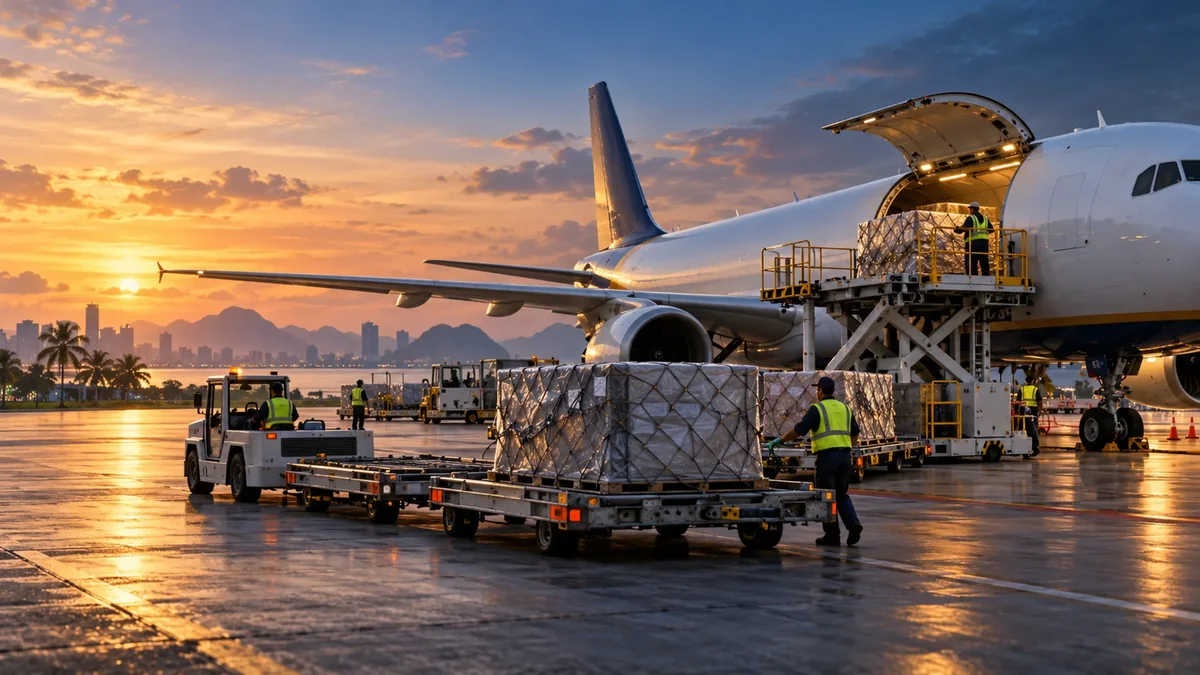
China-to-Southeast-Asia air freight is not always an international long-haul decision. For some lanes, ground or multimodal alternatives may be competitive, but customs border conditions and delivery deadlines need separate evaluation.
Illustrative planning case, not a booked DDP Atlas shipment. A manufacturer in South China supplies a customer in a nearby Southeast Asian market. A quote with fast airport-to-airport time may lose its advantage if customs release and final distribution are slower than an executable cross-border trucking plan.
Route data that shapes the China–Southeast Asia air corridor
| Priority | Evidence or input |
|---|---|
| 1 | Destination country and city |
| 2 | Commodity import permission |
| 3 | Air versus ground eligibility |
| 4 | Origin consolidation |
| 5 | Arrival clearance process |
| 6 | Last-mile handover |
Illustrative planning case, not a booked DDP Atlas shipment. A manufacturer in South China supplies a customer in a nearby Southeast Asian market. A quote with fast airport-to-airport time may lose its advantage if customs release and final distribution are slower than an executable cross-border trucking plan.
Key takeaways
- China-to-Southeast Asia air freight should be planned around the complete corridor, not a generic country-level transit claim.
- Arrival options can include Singapore, Bangkok, Kuala Lumpur, Manila, Jakarta, Ho Chi Minh City and other regional gateways; the best gateway changes with current schedule, customs setup and final delivery.
- Key checks include short-haul schedule frequency, customs requirements, cross-border/onward delivery and whether express is competitive for small shipments.
- Select the destination airport together with final-mile economics.
- Use route redundancy where inventory deadlines are critical.
The decision in one table
| Decision point | What to check |
|---|---|
| China gateway | Match origin region to the most reliable viable uplift. |
| Arrival gateway | Evaluate customs and inland delivery from the destination airport. |
| Routing | Compare direct and connecting options around deadline and handling risk. |
| Door delivery | Include customs, terminal recovery and final receiving requirements in the route plan. |
Information to send for the China–Southeast Asia air corridor
- China pickup city and preferred/available origin gateways.
- Destination city and final delivery postcode.
- Importer/broker details and customs responsibility.
- Cargo dimensions, weight and special characteristics.
- Delivery deadline and acceptable routing options.
- Receiving hours, appointments and final-mile constraints.
Planning example: the China–Southeast Asia air corridor
Short-haul China-to-Southeast-Asia lanes can have frequent flights, making schedule and cut-off important. For very small urgent shipments, express courier may also be competitive, so mode choice should be tested rather than assumed.
Where the China–Southeast Asia air corridor goes wrong
Planning around flight time. On a corridor where the flight is short, the flight is no longer the constraint. Origin cut-off, departure frequency and destination clearing usually dominate.
Treating the region as one lane. Each destination state applies its own import requirements. A regional distribution programme needs a country-by-country clearance plan.
Assuming regional product rules are aligned. Restrictions on a product category can differ between neighbouring countries, so an approval valid in one market proves nothing about the next.
Over-consolidating for a short corridor. Holding a shipment to fill a consolidated consignment can cost more in lost time than the freight saving is worth when the flight is only a few hours.
Where China–Southeast Asia air cargo actually lands
Air freight from China into South-East Asia arrives through Singapore Changi (SIN), Bangkok Suvarnabhumi (BKK), Kuala Lumpur (KUL), Jakarta Soekarno–Hatta (CGK), Manila (MNL) and Ho Chi Minh City Tan Son Nhat (SGN) or Hanoi Noi Bai (HAN) in Viet Nam. Flight times on this corridor are short in comparison with Europe or North America, which changes what the air leg is actually buying.
When the flight itself is only a few hours, the air leg stops being the dominant part of the timeline, and the constraint shifts to origin handling, departure frequency and the destination-side clearing and delivery process. A corridor plan built around a headline flight time therefore optimises the smallest component of the journey.
The other structural feature is that South-East Asia is not a single customs regime. Each destination state applies its own import requirements and its own documentation expectations, and product-specific restrictions can differ sharply between neighbouring countries. For a regional distribution programme, that usually means the arrival airport and the clearing entity have to be decided country by country rather than as one regional lane.
Planning the South-East Asian half of this corridor
On this corridor the flight is short, so the destination process — not the air leg — is what the plan has to be built around. Each destination state applies its own import regime, and neighbouring countries differ enough that one regional plan will not cover them.
| Element | How it works | What the buyer must settle |
|---|---|---|
| Customs regime | Each destination state administers and applies its own import rules | The destination state, and a clearance plan for that state specifically |
| Documentation | Document expectations and the treatment of low-value consignments differ by state | That the origin document set matches the destination’s expectations |
| Product rules | Category restrictions are set nationally and are not aligned across the region | Whether this country permits the product, independently of what a neighbouring country allows |
| Departure frequency | Frequent short-hop departures reduce the value of holding cargo for a larger consignment | Whether consolidation is worth the waiting time on a corridor this short |
| Origin handling | With a short flight, origin cut-off and terminal handling dominate the timeline | The origin cut-off, which is the real constraint rather than the flight time |
| Distribution | Urban delivery from the arrival airport, often within the same metropolitan area | The delivery plan, which is usually short and predictable once cleared |
Because the air leg is short, the sensitivity of the whole shipment to a destination delay is high: a day lost at the destination is a large share of the total transit time. That makes the destination document set and the clearing party the two items most worth settling in advance on this corridor.
Related guides
China to Southeast Asia Air Freight: Regional Gateway and Route Guide continues the Air Freight from China hub.
- Air Freight Routes from China: Corridors Gateways & Destinations
- China to Canada Air Freight: Vancouver and Toronto Gateway Planning
- China to USA Air Freight Corridors: Gateway and Routing Strategy
- Browse Southeast Asia shipping routes
Guides that continue from China to Southeast Asia Air Freight: Regional Gateway and Route Guide:
Operational verification: airline acceptance, dangerous-goods rules, battery requirements, customs procedures, schedules, capacity and charges can change. Confirm current requirements for the actual cargo, carrier, route and booking date.
Related air-freight guidance.
Use these links to move up the cluster or compare the most relevant sibling decision.