
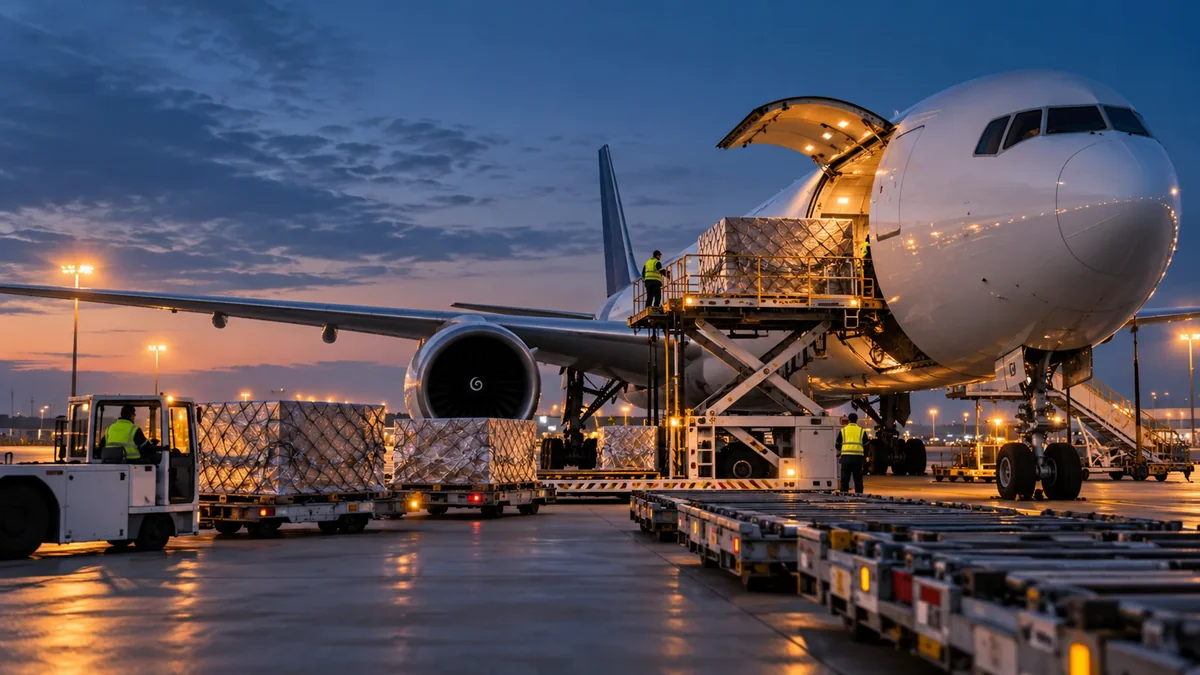
Europe is not one air-import market. An arrival in Germany, the Netherlands or France may lead to different customs, onward-trucking and consignee arrangements even when the ultimate buyer is located elsewhere in the EU.
Illustrative planning case, not a booked DDP Atlas shipment. A buyer in central Europe receives options arriving at two different EU airports. Compare trucking and customs brokerage arrangements—not just the air leg—to avoid a shipment that lands quickly but remains uncollected.
Route data that shapes the China–Europe air corridor
| Priority | Evidence or input |
|---|---|
| 1 | EU importer and EORI |
| 2 | Arrival state |
| 3 | ICS2 ENS data responsibilities |
| 4 | Destination VAT and duty treatment |
| 5 | Cross-border final-mile plan |
| 6 | Document completeness |
Illustrative planning case, not a booked DDP Atlas shipment. A buyer in central Europe receives options arriving at two different EU airports. Compare trucking and customs brokerage arrangements—not just the air leg—to avoid a shipment that lands quickly but remains uncollected.
Key takeaways
- China-to-Europe air freight should be planned around the complete corridor, not a generic country-level transit claim.
- Arrival options can include Frankfurt, Amsterdam, Paris, Liège, Luxembourg and other major cargo gateways depending on service; the best gateway changes with current schedule, customs setup and final delivery.
- Key checks include EU/market customs setup, VAT/import structure, airport choice versus inland delivery, direct versus connecting route.
- Select the destination airport together with final-mile economics.
- Use route redundancy where inventory deadlines are critical.
The decision in one table
| Decision point | What to check |
|---|---|
| China gateway | Match origin region to the most reliable viable uplift. |
| Arrival gateway | Evaluate customs and inland delivery from the destination airport. |
| Routing | Compare direct and connecting options around deadline and handling risk. |
| Door delivery | Include customs, terminal recovery and final receiving requirements in the route plan. |
Information to send for the China–Europe air corridor
- China pickup city and preferred/available origin gateways.
- Destination city and final delivery postcode.
- Importer/broker details and customs responsibility.
- Cargo dimensions, weight and special characteristics.
- Delivery deadline and acceptable routing options.
- Receiving hours, appointments and final-mile constraints.
Planning example: the China–Europe air corridor
A shipment sold into continental Europe can arrive through several major cargo gateways. Airport choice should reflect customs setup and inland delivery, not a generic assumption that the nearest capital-city airport is best.
Where the China–Europe air corridor goes wrong
Assuming the EU entry point does not matter. Goods enter the customs union where they first arrive or where they are formally presented; that is where the import formalities happen unless a customs procedure says otherwise.
Leaving the pre-arrival data owner undefined. The pre-arrival security data obligation has to be assigned to a named party in advance. Discovering the gap when the flight is already airborne is expensive.
Confusing VAT with duty. They are separate charges, both sitting with the importer of record, and neither is inside an airport-to-airport quotation.
Planning a cross-border delivery as if it were domestic. Moving goods on from the entry member state to another country of delivery changes the paperwork and can change where the formalities actually take place.
Where China–Europe air cargo actually lands
European air imports from China concentrate on a handful of hub airports: Frankfurt (FRA), Paris Charles de Gaulle (CDG), Amsterdam Schiphol (AMS), London Heathrow (LHR), Madrid (MAD), Milan Malpensa (MXP), Brussels (BRU) and the dedicated freighter airport at Liège (LGG). Because the European Union is a customs union, the point at which goods enter determines where the import formalities take place, and goods can then move between member states without a further import declaration.
That structure creates the main planning question for this corridor. Goods entering the EU at one member state and delivered to another still have to complete import formalities at the point of entry — or move under a customs procedure that defers them — and the party responsible for the pre-arrival security data has to be identified in advance. The European Commission operates the Import Control System for that pre-arrival data, and the current requirements should be confirmed with the broker handling the entry rather than assumed from an earlier shipment.
Value added tax is a further difference from a domestic transport movement: VAT on import is a distinct charge from duty, it falls on the importer of record, and it is not included in an airport-to-airport freight quotation. A corridor comparison that stops at the arrival airport therefore omits two of the largest destination-side items.
Planning the European half of this corridor
A China–Europe shipment is cleared into a customs union rather than into a single country. That single fact changes the destination plan, because the entry point determines where the import formalities happen and what can happen afterwards without a further declaration.
| Element | How it works | What the buyer must settle |
|---|---|---|
| Entry point | Goods enter the union where they arrive or are presented; formalities attach to that point | Which member state of entry is being used, and why |
| Customs authority | The national customs authority of the member state of entry administers the declaration | The broker making the entry, and on whose behalf |
| Pre-arrival data | The union operates a pre-arrival security data requirement for cargo entering it | Which party lodges the data, and that it is lodged in time |
| VAT | VAT on import is an EU-level tax, separate from duty and from freight | Who accounts for it and how it is funded at arrival |
| Onward movement | Movement between member states does not require a further import declaration, but may require a customs procedure | Whether the chosen procedure matches where the goods are actually consumed |
| Inland reach | Road and rail distribution from the entry hub across the union | The inland date, which usually dominates the door-to-door timeline |
The practical mistake on this corridor is planning the air leg to the cheapest European hub and then treating the onward move as domestic. It is not: it is a customs movement, it may need a procedure, and it changes who can clear the goods and where. Deciding the entry point from the delivery destination, rather than from the flight option, is what keeps the destination half of the corridor under control.
Related guides
China to Europe Air Freight Corridors: Gateway and Routing Strategy continues the Air Freight from China hub.
- Air Freight Routes from China: Corridors Gateways & Destinations
- China to USA Air Freight Corridors: Gateway and Routing Strategy
- China to UK Air Freight: Heathrow and Regional Gateway Planning
- China to Southeast Asia Air Freight: Regional Gateway and Route Guide
Guides that continue from China to Europe Air Freight Corridors: Gateway and Routing Strategy:
- Air Freight Routes from China: Corridors Gateways & Destinations
- China to USA Air Freight Corridors: Gateway and Routing Strategy
- China to UK Air Freight: Heathrow and Regional Gateway Planning
- China to Southeast Asia Air Freight: Regional Gateway and Route Guide
- Air Freight from China hub
- Standard air-freight operating checklist
Operational verification: airline acceptance, dangerous-goods rules, battery requirements, customs procedures, schedules, capacity and charges can change. Confirm current requirements for the actual cargo, carrier, route and booking date.
Related air-freight guidance.
Use these links to move up the cluster or compare the most relevant sibling decision.