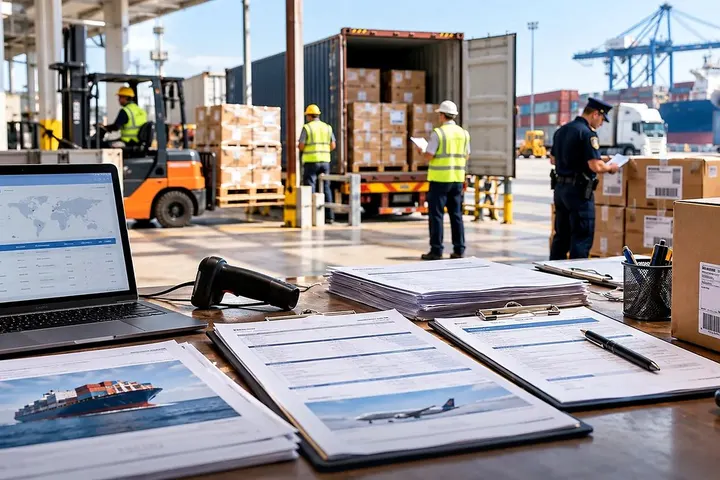
A customs hold does not automatically mean something is wrong. Customs authorities use document review, risk assessment, regulatory checks and physical inspections to verify imports.
The correct response is not to look for a shortcut. It is to understand the request, provide consistent information and keep the shipment record organized.
This guide explains customs holds and inspections from an importer’s operational perspective.
Common types of customs delay
Terminology differs by country, but a shipment may be delayed because of:
- document review;
- tariff-classification questions;
- valuation questions;
- importer verification;
- product-agency review;
- security screening;
- physical inspection;
- intensive exam;
- missing permit or registration;
- mismatch between manifest and entry data.
The forwarder or customs broker should identify the authority/request whenever possible.
Why shipments are selected
Incomplete or inconsistent descriptions
“Parts,” “samples” or “accessories” may be too vague.
Use a commercially meaningful description such as:
“women’s knitted polyester dresses”
instead of
“clothes.”
HS classification questions
A tariff code should match the actual product composition and use. Incorrect classification can affect duty, admissibility and statistical reporting.
Value questions
Customs may request evidence supporting the declared transaction value.
Maintain:
- commercial invoice;
- purchase records;
- payment evidence where appropriate;
- assists/royalties information where relevant;
- related-party information when applicable.
Importer information problems
Missing registration, bond, tax number or authorization can stop the entry.
Regulated products
Some products involve agencies beyond customs.
Examples may include food, medical devices, cosmetics, chemicals, wireless devices, children’s products or other regulated categories depending on market.
Freight service does not replace product compliance.
Random or risk-based inspection
Even accurate shipments can be inspected.
Importers should budget time and contingency for this possibility.
What happens during a customs hold?
A simplified process is:
- entry or manifest is reviewed;
- authority requests information or inspection;
- broker/forwarder informs the importer;
- documents are submitted;
- cargo may be moved to an exam facility;
- authority completes review;
- shipment is released or further action is requested;
- destination delivery resumes.
The importer should keep one source of truth for all submitted information.
What documents may be requested?
Depending on the issue:
- commercial invoice;
- packing list;
- bill of lading / air waybill;
- purchase order;
- product literature;
- composition/specification;
- HS classification support;
- country of origin information;
- licenses/permits;
- importer registration;
- test reports or certificates where legally required.
Do not create documents after the fact merely to satisfy a request. Provide accurate supporting records.
What should the importer do first?
1. Identify the exact hold
Ask:
- which authority;
- which entry/shipment;
- reason or request code;
- deadline;
- required documents;
- whether physical exam is ordered.
2. Centralize communication
Avoid sending conflicting answers from supplier, buyer and forwarder.
Designate one responsible person.
3. Check the commercial documents
Verify that invoice, packing list, transport document and customs entry agree.
4. Respond precisely
Provide what is requested and explain discrepancies clearly.
5. Track storage exposure
A customs hold can create storage or equipment cost even when the importer cannot control the inspection timeline.
Ask the forwarder to identify:
- free-time status;
- storage start;
- exam facility charges;
- container detention risk;
- next delivery step after release.
How to reduce avoidable holds
No process can guarantee that customs will never inspect a shipment.
But importers can reduce avoidable problems by:
- using specific product descriptions;
- reviewing HS codes before departure;
- declaring accurate values;
- keeping supplier invoices consistent;
- confirming importer registration;
- preparing product-compliance documents;
- declaring batteries, chemicals or restricted cargo;
- avoiding last-minute document changes.
Physical inspection planning
If a physical exam is ordered:
- the container/pallet may need transfer;
- seals may be handled under authority procedures;
- additional handling can occur;
- release timing is controlled by the authority;
- exam/handling/storage charges may apply.
The forwarder should not promise an exact release date unless the authority has confirmed it.
Customs hold response checklist
- authority and request identified;
- broker contact confirmed;
- entry number/reference collected;
- invoice checked;
- packing list checked;
- HS classification support available;
- value support available;
- product compliance reviewed;
- response deadline tracked;
- storage/free-time exposure monitored;
- delivery plan ready after release.
What not to do
Do not understate product value to “solve” duty
Valuation must follow applicable customs law.
Do not change the description just to fit a preferred tariff code
Classification should be supported by the actual product.
Do not ask the forwarder to bypass a regulatory requirement
A logistics provider cannot lawfully remove a product-compliance obligation.
Do not send inconsistent documents
Corrections should be transparent and coordinated.
FAQ
Does a customs hold mean the shipment will be seized?
No. Many holds are routine reviews or inspections. The outcome depends on the shipment and applicable law.
Who communicates with customs?
Usually the customs broker or authorized representative handles the entry communication, with information supplied by the importer and shipper.
Can customs inspections create extra cost?
Yes. Exam handling, storage, transfer and equipment time can create charges depending on the country and shipment.
Can a forwarder guarantee no customs delay?
No responsible forwarder can guarantee that a customs authority will not review or inspect a shipment.
Prepare before departure
The strongest customs strategy is built before the cargo leaves China: specific product data, consistent documents, reviewed classification and an importer that is ready to clear the goods.
DDP Atlas coordinates shipment documents and customs handoff, while the importer and relevant licensed professionals remain responsible for product and import compliance as applicable.
Related planning resources: See how customs clearance works, use the shipping documents checklist, compare DDP shipping, or request a freight estimate.
Part of the Customs & Compliance hub — see the wider freight planning map.