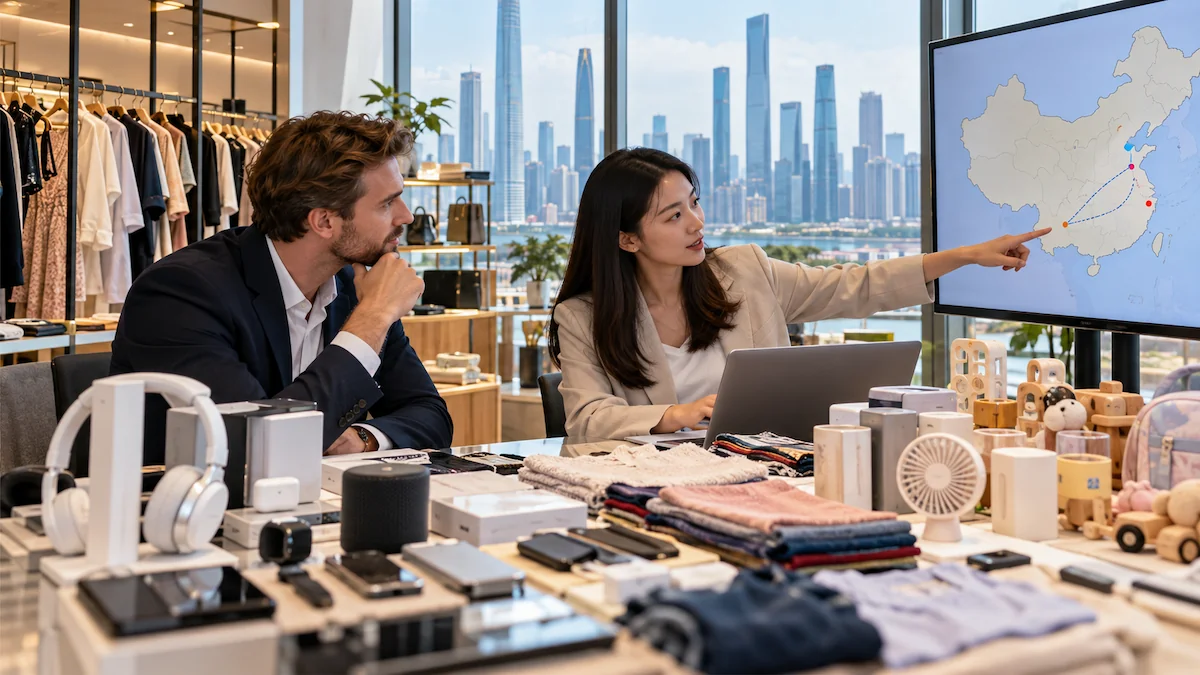
Shenzhen, Guangzhou and Yiwu are three of the most recognized sourcing locations in China, but they are not interchangeable.
Shenzhen is closely connected with electronics, hardware, technology supply chains and the wider Pearl River Delta manufacturing network. Guangzhou is a major commercial and manufacturing hub with deep supplier ecosystems across apparel, accessories, beauty, consumer goods and many other categories. Yiwu is famous for wholesale sourcing and small commodities, with an ecosystem built around broad assortment and trade.
A buyer who searches all three cities in the same way will waste time. The better approach is to match the sourcing method to the product and to the role each location plays in the supply chain.
First: city names are sourcing clues, not guarantees
A supplier with “Shenzhen” in its profile may produce in Dongguan, Huizhou or another nearby city. A Guangzhou trading company may source from factories elsewhere in Guangdong. A Yiwu seller may be a wholesaler representing products made in Zhejiang or other provinces.
That is normal.
Verify:
- legal entity;
- office location;
- actual production location;
- warehouse location;
- which facility will produce your order.
Think in terms of industrial clusters, not city boundaries.
Shenzhen: best when technology and fast supplier networks matter
Shenzhen is a strong starting point for:
- consumer electronics;
- electronic accessories;
- smart devices;
- hardware;
- LED products;
- communications equipment;
- electronics-related components;
- product development that depends on rapid access to suppliers and engineers.
Its advantage is not only factories inside Shenzhen. It is access to the broader Guangdong manufacturing network.
How to search Shenzhen suppliers
Use:
- Alibaba.com manufacturer search;
- Global Sources and other B2B directories where relevant;
- trade fairs;
- product-specific exhibitions;
- referrals from component suppliers;
- sourcing agents;
- factory visits;
- local industrial parks.
Search the product rather than only the city.
For example:
- “USB-C hub manufacturer Guangdong”
- “LED driver factory Shenzhen Dongguan”
- “custom electronics enclosure manufacturer Pearl River Delta”
A precise product/process search often performs better than “Shenzhen manufacturer.”
Questions to ask Shenzhen technology suppliers
- Which engineering functions are in-house?
- Who owns the tooling?
- Which certifications apply to the exact model?
- Can you provide test reports for the current configuration?
- Which components are critical to lead time?
- What happens when a component is discontinued?
- How are firmware versions controlled?
- What is the procedure for engineering changes?
For electronics, supplier verification should extend into component sourcing and test capability.
Guangzhou: broad sourcing depth and commercial access
Guangzhou is useful for many consumer categories, including:
- apparel and fashion;
- footwear and bags;
- beauty and cosmetics-related products;
- accessories;
- home and consumer goods;
- auto-related categories;
- packaging and supporting products.
The surrounding Pearl River Delta gives buyers access to dense supplier networks, markets and specialized production zones.
Manufacturer versus wholesale-market sourcing
Guangzhou buyers often encounter both factories and market traders.
Wholesale markets can be excellent for:
- trend discovery;
- sample purchasing;
- ready-stock assortment;
- identifying product categories;
- comparing construction and price levels.
They are not automatically factories.
If custom manufacturing matters, ask the seller:
- who manufactures the product;
- whether MOQ applies per color/design;
- what changes can be made;
- where the factory is located;
- whether a factory visit is possible;
- who controls QC.
Yiwu: powerful for assortment and small commodities
Yiwu is one of China's best-known small-commodity sourcing ecosystems.
It is particularly useful for buyers sourcing:
- accessories;
- gifts;
- promotional items;
- stationery;
- home accessories;
- seasonal goods;
- party items;
- small hardware;
- low-unit-value consumer goods;
- broad mixed assortments.
The strength of Yiwu is choice and trade infrastructure.
The challenge is that a buyer may deal with wholesalers, agents and manufacturers in the same sourcing trip.
When Yiwu is especially useful
Yiwu is attractive when a buyer needs:
- many SKUs;
- relatively small quantities per SKU;
- broad selection;
- fast sample comparison;
- consolidation of multiple domestic suppliers.
A single retailer may source dozens of small categories. In that situation, China-side consolidation becomes part of the sourcing strategy rather than a later freight decision.
How to build a manufacturer shortlist
Regardless of city, use a scoring system.
|
Criterion |
Weight idea |
|---|---|
|
--- |
---: |
|
Product/process fit |
25% |
|
Sample quality |
20% |
|
Quality-control system |
15% |
|
Communication |
10% |
|
Commercial terms |
10% |
|
Lead-time reliability |
10% |
|
Export/document capability |
5% |
|
Location/logistics fit |
5% |
Price belongs in the score, but it should not replace capability.
1. Search by product + process + location
Weak:
“Guangzhou supplier”
Better:
“women's woven dress manufacturer Guangzhou”
Stronger:
“small MOQ woven dress factory Guangdong digital print”
The more specific the product/process, the more useful the shortlist.
2. Request a structured supplier response
Send each supplier the same RFQ:
- product;
- material;
- dimensions;
- quantity;
- packaging;
- customization;
- target market;
- required test/certification;
- target delivery window.
Then compare responses side by side.
If every supplier receives a different question, the quotations will not be comparable.
3. Verify legal identity
Check:
- Chinese legal company name;
- business license;
- public corporate record;
- payment beneficiary;
- factory address;
- export entity where relevant.
For a detailed process, internally link to:
How to Verify a Chinese Supplier Before Paying
4. Order samples strategically
Do not order one random sample from every supplier.
Select a shortlist first, then test the suppliers against the same criteria.
For custom products:
- use one specification;
- request the same material;
- request the same packaging;
- record deviations.
A controlled sample process is a supplier test.
5. Plan the factory visit around questions
A factory visit is not tourism.
Prepare a list:
- raw material storage;
- production flow;
- capacity bottleneck;
- QC checkpoints;
- finished goods;
- rework area;
- subcontracted processes;
- traceability;
- packaging;
- current production.
Take notes immediately after each visit so factories do not blur together.
6. Use geography to improve logistics
Geography also decides how the cargo leaves China, so it is worth pairing a city shortlist with what each sourcing city is best for by product category and with the option of a single China consolidation point once suppliers in more than one city are involved.
Supplier geography matters after sourcing.
If five suppliers are all in Guangdong, one South China receiving warehouse can simplify pickup and consolidation.
If suppliers are split across Guangdong, Zhejiang and Jiangsu, compare:
- domestic trucking/courier cost;
- readiness dates;
- international gateway;
- shipment size;
- whether two regional consolidations are better than one nationwide collection plan.
Do not select a supplier only because it is closer to a port, but include domestic logistics in the total-cost model.
A practical three-city sourcing strategy
If the product is electronics-heavy
Start with Shenzhen and the surrounding Guangdong electronics cluster.
If the product is fashion/consumer-goods heavy
Start with Guangzhou and nearby manufacturing cities.
If the product is a broad assortment of small commodities
Start with Yiwu and build a strong consolidation process.
If the product crosses categories
Source each category where it is strongest, then combine the orders operationally.
This is often better than forcing one supplier to provide everything.
Red flags during city-based sourcing
- supplier refuses to state actual production location;
- “factory” visit turns out to be only a showroom;
- payment goes to an unexplained third party;
- product samples clearly come from unrelated producers;
- seller cannot explain process or QC;
- claimed certificates do not match the legal entity/model;
- factory capacity claims conflict with what is visible;
- quotation excludes important packaging or export preparation without saying so.
Frequently asked questions
Is Shenzhen only for electronics?
No, but electronics and technology supply chains are a major reason buyers source there.
Is Guangzhou good for clothing manufacturers?
Yes, Guangzhou and the wider Guangdong region have extensive fashion and textile supply chains, but buyers should verify the exact factory and production location.
Is Yiwu only a wholesale market?
Yiwu is a wider trade ecosystem. Buyers may encounter manufacturers, wholesalers, agents and specialized service providers.
Should I use a sourcing agent?
An agent can add value when you need local-language support, market access or supplier coordination. Define fees, responsibilities, conflict-of-interest rules and inspection scope clearly.
Can I buy from all three cities and consolidate the cargo?
Yes. Whether it is efficient depends on domestic transport, shipment size, timing and the chosen international gateway.
Related guides: how to buy from multiple suppliers in China · how to verify a Chinese supplier before paying
Need a China-side freight partner?
After supplier selection, the operational challenge is moving goods from different factories and cities into one controlled export plan.
DDP Atlas can coordinate supplier pickup, China warehouse receiving, carton measurement, agreed preparation and international freight from major manufacturing regions.
Explore China Consolidation: China consolidation and supplier receiving
Compare Freight Services: compare freight services
Part of the Shipping from China hub — see the wider freight planning map.